

If you’ve ever tried to estimate how much weight a full tank adds to your car, or wondered why a jerry can feels heavier than you expected, you’ve probably asked yourself how much does a gallon of gas weigh. It’s one of those everyday questions that sounds simple but actually depends on a few variables most drivers never think about.
In plain terms, a gallon of gasoline weighs somewhere between 6.0 and 6.3 pounds, with most sources landing on an average of about 6.15 pounds per gallon at typical temperatures.
That’s noticeably lighter than a gallon of water, which weighs about 8.34 pounds, because gasoline is less dense. The exact weight per gallon shifts slightly depending on the fuel blend,
ethanol content, and outside temperature. This article breaks down everything you need to know about how much a gallon of gas weighs, including conversions, comparisons to other liquids, how tank size affects total fuel weight, and practical examples from cars, trucks, motorcycles, boats, and planes. You’ll also find quick-reference tables,|
Gasoline’s weight is usually expressed in pounds or kilograms per gallon, but it helps to see it converted into other common units too.
| Unit | Value |
| Pounds (lb) | 6.0 – 6.3 lbs |
| Average Weight | 6.15 lbs |
| Kilograms (kg) | 2.72 – 2.86 kg |
| Ounces (oz) | 96 – 100.8 oz |
| Grams (g) | 2,720 – 2,860 g |
| Liters (equivalent volume) | 3.785 L |
A gallon of gas doesn’t have one fixed weight the way a gallon of pure water does, because gasoline is a blended fuel. Small differences in refining, additives, and ethanol percentage all nudge the number up or down slightly, which is why you’ll see a range instead of a single figure.
Quick Reference Table
To help you picture how much a gallon of gas actually weighs, here’s how it compares to familiar everyday items.
| Item | Approximate Weight | How Close to a Gallon of Gas |
| Gallon of whole milk | 8.6 lbs | Heavier |
| Gallon of water | 8.34 lbs | Heavier |
| Bowling ball (light) | 6 lbs | Very close |
| Gallon of gasoline | 6.15 lbs | Exact reference |
| Housecat (average) | 8–10 lbs | Heavier |
| Two-liter soda bottle (full) | 4.4 lbs | Lighter |
| Bag of sugar (5 lb) | 5 lbs | Close |
| Newborn baby (average) | 7.5 lbs | Slightly heavier |
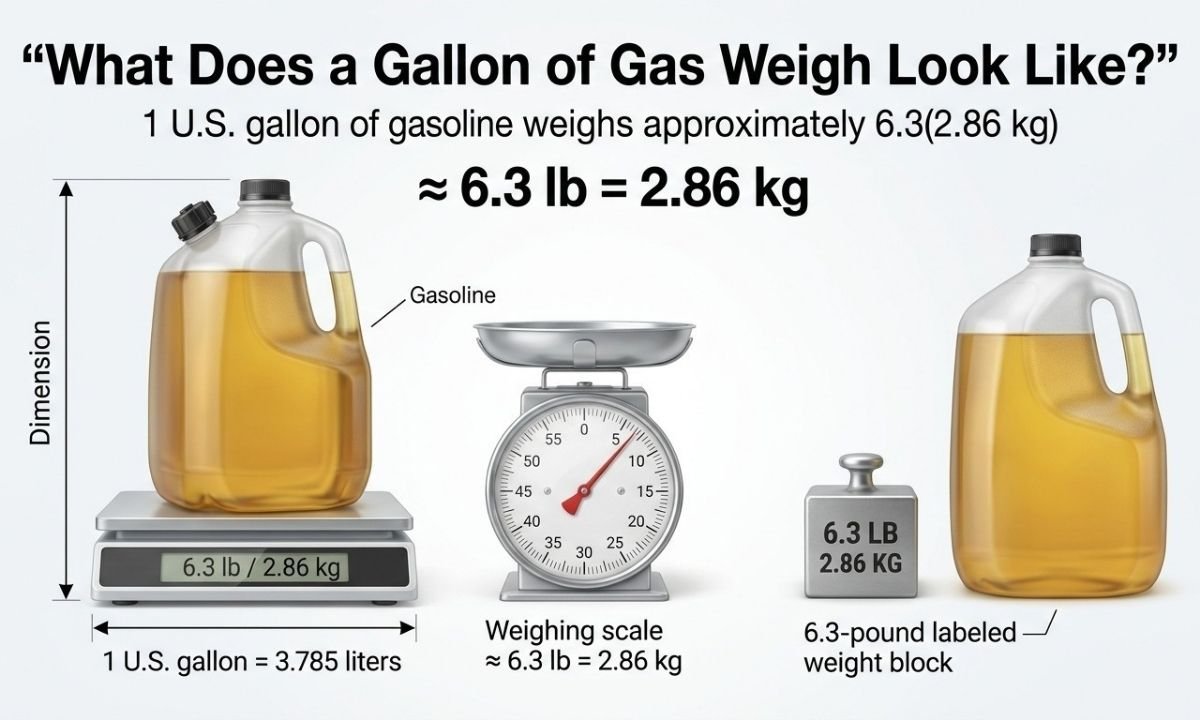
What Does a Gallon of Gas Weigh Look Like?
Picture a standard one-gallon plastic gas can, the kind sold at any hardware store. Empty, it weighs almost nothing. Fill it to the top with gasoline, and it becomes about as heavy as a light bowling ball or a large bag of flour. It’s a weight most adults can lift comfortably with one hand, but noticeable enough that carrying several gallons at once like when refueling a lawn mower, generator, or boat adds up quickly.
Why People Want to Know How Much a Gallon of Gas Weighs
Most people never think about gasoline’s weight until it becomes practically relevant. Drivers estimating payload for a road trip, boat owners calculating how much fuel they can safely carry, pilots doing weight-and-balance checks, and preppers storing emergency fuel all need a reliable answer to how much a gallon of gas weighs.
Even something as simple as loading a truck bed with several full gas cans can affect towing capacity or fuel economy if the added weight isn’t accounted for.
Understanding gasoline’s weight also helps put fuel costs and energy density into perspective, since gasoline is sold by volume (gallons) but its energy content and physical weight are tied to mass, not just liquid measurement.
What Affects How Much Gasoline Weighs Per Gallon
Gasoline isn’t a single pure substance it’s a blended mixture of hydrocarbons and additives, which is why its weight per gallon isn’t perfectly fixed.
Fuel Grade and Gasoline Blend
Regular, mid-grade, and premium gasoline all have slightly different chemical compositions depending on octane rating and refining process. These differences are small, generally shifting the weight per gallon by a fraction of an ounce, but they do mean that regular unleaded and premium fuel won’t weigh exactly the same amount.
Ethanol Content in Gasoline
Most gasoline sold in the U.S. contains up to 10% ethanol (E10), and some blends go higher, like E15 or E85. Ethanol is slightly denser than pure gasoline, weighing about 6.61 pounds per gallon compared to gasoline’s 6.0–6.3 pounds. This means fuel blends with a higher ethanol percentage tend to weigh a bit more per gallon than pure gasoline.
How Temperature Changes Gasoline Weight
Like most liquids, gasoline expands when heated and contracts when cooled. This means a gallon of gas weighs slightly less on a hot summer day than it does on a cold winter morning, because the same mass takes up a bit more volume at higher temperatures.
The difference is small usually a fraction of a percent but it’s part of why fuel weight is always given as a range rather than one exact number.
How Much Does a Gallon of Gas Weigh by Fuel Type?
Different fuel types used in vehicles and equipment have their own typical weight per gallon, and comparing them side by side makes it easier to understand where gasoline falls.
| Fuel Type | Approximate Weight Per Gallon |
| Regular gasoline | 6.0 – 6.3 lbs |
| Premium gasoline | 6.1 – 6.3 lbs |
| E85 (flex-fuel blend) | 6.4 lbs |
| Diesel fuel | 7.0 – 7.1 lbs |
| Jet fuel (Jet A) | 6.7 lbs |
| Kerosene | 6.8 lbs |
Diesel and jet fuel are both heavier than gasoline per gallon because they’re denser hydrocarbon blends, which is one reason diesel engines are often associated with different fuel economy and torque characteristics compared to gasoline engines.
How Much Does a Full Gas Tank Weigh?
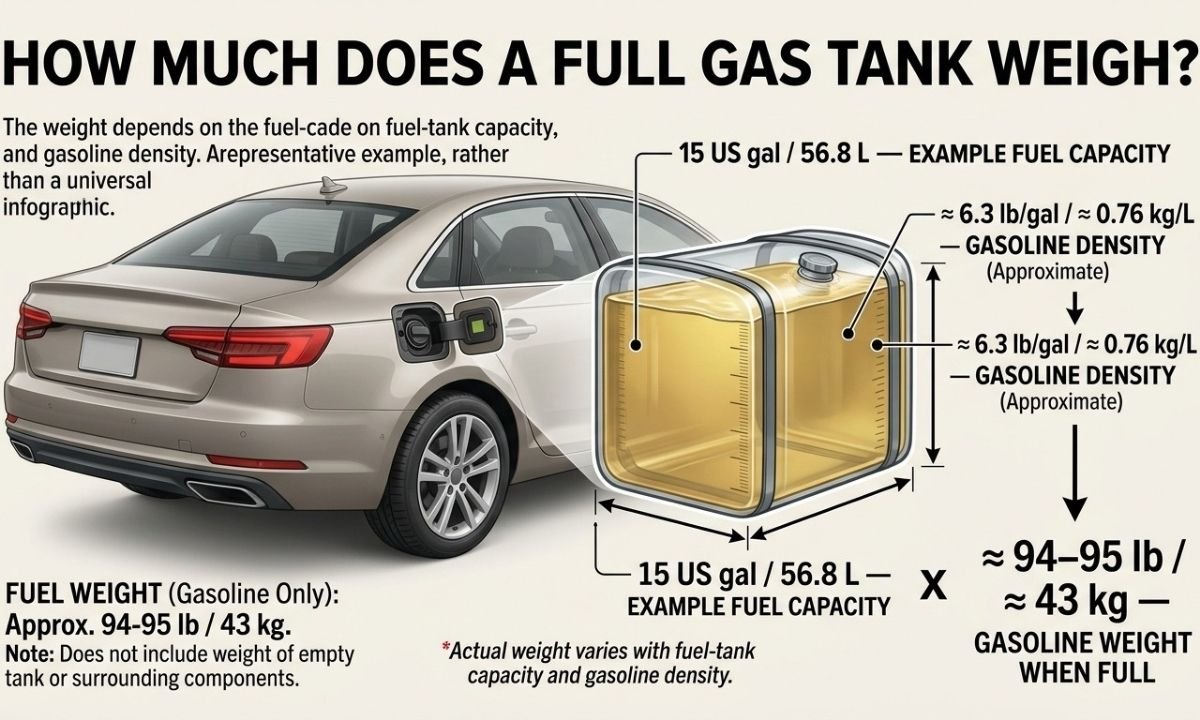
Knowing the weight of a single gallon is useful, but most people really want to know how much fuel adds to their vehicle’s total weight once the tank is full.
Passenger Car Fuel Tank Weight
A typical sedan has a fuel tank capacity of around 12 to 16 gallons. At an average of 6.15 pounds per gallon, a full tank adds roughly 74 to 98 pounds to the car’s overall weight noticeable, but a small percentage of the vehicle’s total mass.
Pickup Truck Fuel Tank Weight
Full-size pickup trucks often have tanks ranging from 26 to 36 gallons, especially in extended-range configurations. That translates to about 160 to 221 pounds of gasoline weight when completely full, which can have a small but real effect on payload and towing calculations.
Motorcycle Fuel Tank Weight
Motorcycle tanks are much smaller, typically holding 3 to 6 gallons. A full tank adds only about 18 to 37 pounds, but on a lightweight bike, that’s still a meaningful percentage of total weight, which is why fuel level can subtly affect handling.
Large Commercial Truck Fuel Tank Weight
Semi-trucks often carry one or two tanks ranging from 100 to 300 gallons combined. At roughly 6.15 pounds per gallon, that’s an added 615 to 1,845 pounds of gasoline or diesel weight a significant factor in commercial weight limits and load planning.
Gallon of Gas Weight Compared to Other Common Liquids
Gasoline is lighter than many everyday liquids because of its lower density. Here’s how it stacks up.
| Liquid | Approximate Weight Per Gallon |
| Gasoline | 6.0 – 6.3 lbs |
| Diesel | 7.0 – 7.1 lbs |
| Water | 8.34 lbs |
| Whole milk | 8.6 lbs |
| Motor oil | 7.5 lbs |
| Rubbing alcohol | 6.6 lbs |
| Honey | 12 lbs |
This comparison shows why gasoline floats on water its lower density means it’s physically lighter per unit of volume, a property that also plays a role in fuel spill behavior and storage safety guidelines.
How Much Do Gas Cans Weigh When Full?
Gas cans are a practical, everyday way people interact with gasoline’s weight directly, whether for lawn equipment, generators, or emergency fuel storage.
| Gas Can Size | Empty Weight (approx.) | Full Weight (approx.) |
| 1 gallon | 0.5 lbs | 6.5 – 6.8 lbs |
| 2 gallons | 1 lb | 13 – 13.6 lbs |
| 5 gallons | 2 – 3 lbs | 32 – 34.5 lbs |
A full 5-gallon gas can is heavy enough that lifting and pouring it safely takes some care, which is worth keeping in mind for anyone refueling equipment or stockpiling fuel for emergencies.
How Gasoline Weight Affects Fuel Economy
Extra weight in a vehicle including a full tank of gas requires more energy to accelerate and move, which has a small but measurable effect on fuel economy. While the difference between a full tank and a near-empty one is usually only a few dozen pounds, some drivers intentionally keep their tanks partially filled to shave a small amount of weight, particularly in fuel-conscious or performance driving contexts.
In practice, the effect is minor compared to tire pressure, driving habits, and vehicle load, but it’s part of the bigger picture of how gasoline’s physical weight interacts with everyday driving.
Why Gasoline Weight Matters More Than You Think
Beyond curiosity, knowing how much a gallon of gas weighs has real, practical applications across several industries and everyday situations.
Gasoline Weight in Aviation
In aviation, weight and balance calculations are critical for safe flight, and fuel is one of the heaviest variable loads a small aircraft carries. Pilots use aviation fuel’s weight per gallon (closer to 6.7 pounds for Jet A, or around 6.0 pounds for aviation gasoline, AvGas) to calculate total aircraft weight before takeoff, since exceeding weight limits affects handling and safety.
Gasoline Weight in Boating
Boaters often carry large fuel tanks, sometimes 50 gallons or more, and that fuel weight factors directly into a boat’s total load capacity, balance, and fuel efficiency. A full tank on a mid-size boat can add several hundred pounds, which matters for both performance and safe weight distribution.
Gasoline Weight for Emergency Preparedness
People storing gasoline for generators, vehicles, or emergency backup often need to know how much their stored fuel will weigh for transport or storage planning. A stockpile of several 5-gallon containers can quickly add up to over 100 pounds, which affects how and where it can be safely stored or moved.
Gasoline Weight in Shipping and Transportation
Companies that transport fuel commercially must account for gasoline’s weight when calculating load limits for trucks, rail cars, and shipping containers, since exceeding legal weight limits carries safety and regulatory consequences.
Fuel weight is one of the more predictable variables in these calculations because gasoline’s density stays within a fairly narrow range.
How to Calculate Gasoline Weight by Gallon
Calculating gasoline weight is straightforward once you know the density. Multiply the number of gallons by the average weight per gallon (about 6.15 pounds) to get a close estimate. For example, 10 gallons of gasoline would weigh approximately 61.5 pounds. For more precision, factor in ethanol content and temperature, since both can shift the total by a few percentage points.
Gasoline Weight and Fuel Cost Calculator
While gasoline is priced by the gallon rather than by weight, it can be useful to connect the two. If gas costs $3.50 per gallon and weighs about 6.15 pounds, that works out to roughly $0.57 per pound of fuel.
This kind of comparison is mostly useful for understanding fuel value relative to other liquids or for rough weight-based cost estimates when transporting larger quantities of fuel.
| GallonsPurchased | Approximate Weight | Estimated Cost (at $3.50/gal) |
| 5 gallons | 30.75 lbs | $17.50 |
| 10 gallons | 61.5 lbs | $35.00 |
| 15 gallons | 92.25 lbs | $52.50 |
| 20 gallons | 123 lbs | $70.00 |
Frequently Asked Questions
How much does a gallon of gas weigh on average?
A gallon of gas weighs about 6.15 pounds on average, though it can range from roughly 6.0 to 6.3 pounds depending on the blend and temperature.
Does premium gas weigh more than regular gas?
Premium gasoline weighs only slightly more than regular gasoline, with the difference typically being a fraction of an ounce per gallon.
Why does a gallon of gas weigh less than a gallon of water?
Gasoline is less dense than water, which is why a gallon of gas weighs about 6.15 pounds compared to water’s 8.34 pounds per gallon.
Does temperature really change how much a gallon of gas weighs?
Yes, gasoline expands slightly in heat and contracts in cold, so its weight per gallon shifts by a small amount depending on the outside temperature.
How much does a full 5-gallon gas can weigh?
A full 5-gallon gas can typically weighs between 32 and 34.5 pounds, including the weight of the container itself.
Does ethanol make gasoline heavier?
Yes, ethanol is denser than pure gasoline, so fuel blends with higher ethanol content, like E15 or E85, tend to weigh slightly more per gallon.
How much does a full gas tank add to a car’s weight?
A full gas tank typically adds between 74 and 98 pounds to a passenger car, depending on the size of the tank.
Is diesel heavier than a gallon of gas?
Yes, diesel weighs more than gasoline, coming in at about 7.0 to 7.1 pounds per gallon compared to gasoline’s 6.0 to 6.3 pounds.
Conclusion
A gallon of gas weighs approximately 6.15 pounds on average, generally falling between 6.0 and 6.3 pounds depending on fuel grade, ethanol content, and temperature.
That’s noticeably lighter than water, milk, or diesel, but heavy enough to matter when it comes to full gas tanks, gas cans, aviation weight limits, and commercial fuel transport.
The easiest way to remember it: a gallon of gasoline weighs about as much as a light bowling ball. Whether you’re filling up your car, storing emergency fuel, or just satisfying your curiosity, that simple comparison makes the weight of a gallon of gas easy to picture and easy to calculate for any amount you’re working with.