

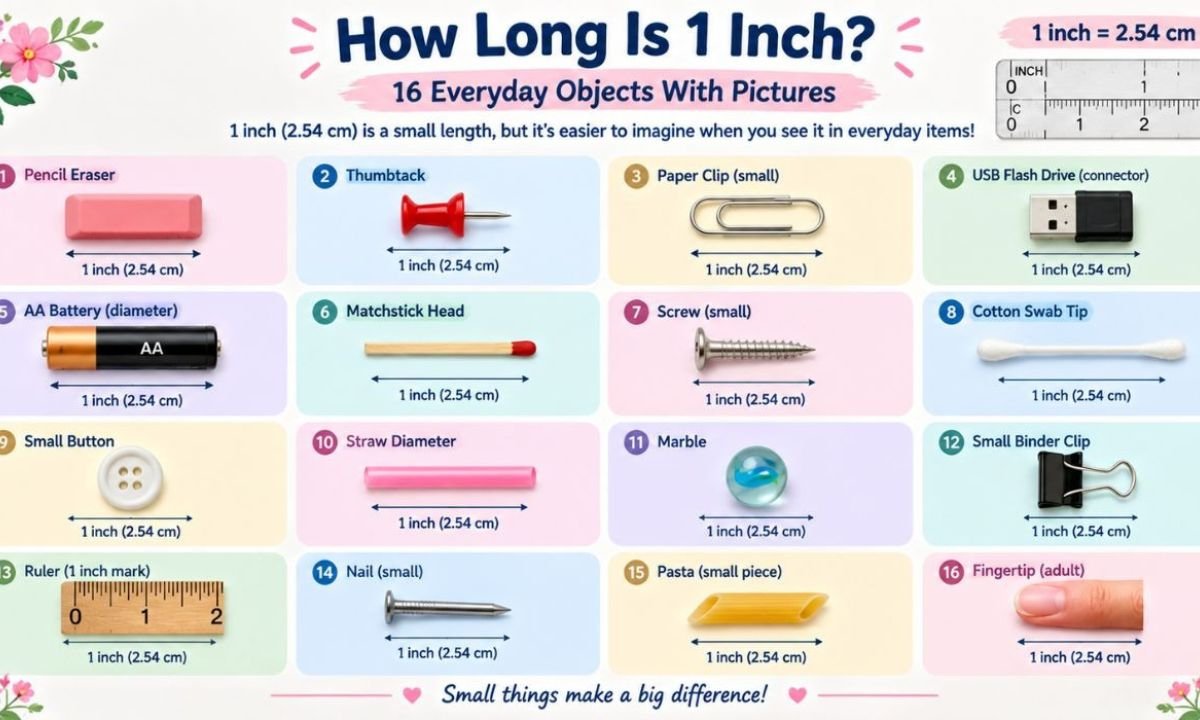
Most of us know an inch exists, but few can picture its exact length without holding up a ruler. Whether you’re hanging a picture frame, checking if a package will fit through a mail slot, or just curious about how long is 1 inch compared to things you already own, the answer is easier to grasp than you might think.
An inch is one of the most commonly used units of length in the imperial measurement system, especially in the United States. It’s small enough to fit on a fingertip, yet it shows up constantly in daily life from screen sizes to shoe sizes to the width of a standard button.
Understanding how long 1 inch actually is becomes much simpler once you compare it to familiar objects you already touch every day.
This article breaks down exactly how long 1 inch is, how it converts into centimeters, millimeters, and other common units, and how it compares to 16 everyday objects from paperclips and quarters to LEGO bricks and AA batteries.
You’ll also find quick-reference tables, practical no-ruler measuring tricks, and answers to the most common questions people ask about this everyday unit.
Quick Conversion / Measurement Reference
Before diving into object comparisons, here’s a fast breakdown of what 1 inch equals in other common units of measurement.
| Unit | Value |
| Inches (main unit) | 1 in |
| Centimeters | 2.54 cm |
| Millimeters | 25.4 mm |
| Meters | 0.0254 m |
| Feet | 0.0833 ft |
An inch is a fixed, standardized unit 1 inch always equals exactly 2.54 centimeters, no rounding needed. This makes it easy to switch between imperial and metric systems when you’re reading a ruler, a tape measure, or a product label from another country.
Quick Reference Table
Here’s a snapshot of how 1 inch lines up against common household and everyday items, several of which are covered in more detail later in this article.
| Item | Approximate Length / Size | How Close to 1 Inch |
| Standard paperclip | 1 in (length) | Exact |
| Quarter coin | 0.955 in (diameter) | Very close |
| AA battery | 0.57 in (diameter) | Close (width, not length) |
| Wine cork | 0.95–1 in (diameter) | Very close |
| Bottle cap | 1.18 in (diameter) | Close |
| Standard dice | 1 in (each side) | Exact |
| Golf tee | 2.125 in (length) | Close (roughly double) |
| Adult thumb width | 1 in (average) | Very close |
What Does 1 Inch Look Like?
Picture the width of an adult thumb at its base, or the length of the last joint on your index finger that’s roughly how long 1 inch is. It’s also about the width of a standard paperclip laid flat, or the diameter of a quarter coin. If you stack three standard LEGO bricks on top of each other, you’ll come close to the same height.
These everyday references make it much easier to visualize an inch without needing a tape measure nearby, and they’re a handy trick any time you need a rough estimate on the go.
Everyday Office and Stationery Items That Are 1 Inch Long
Office supplies are some of the most reliable references for visualizing 1 inch, since many are manufactured to standardized sizes.
Standard Paperclip Length (1 Inch)
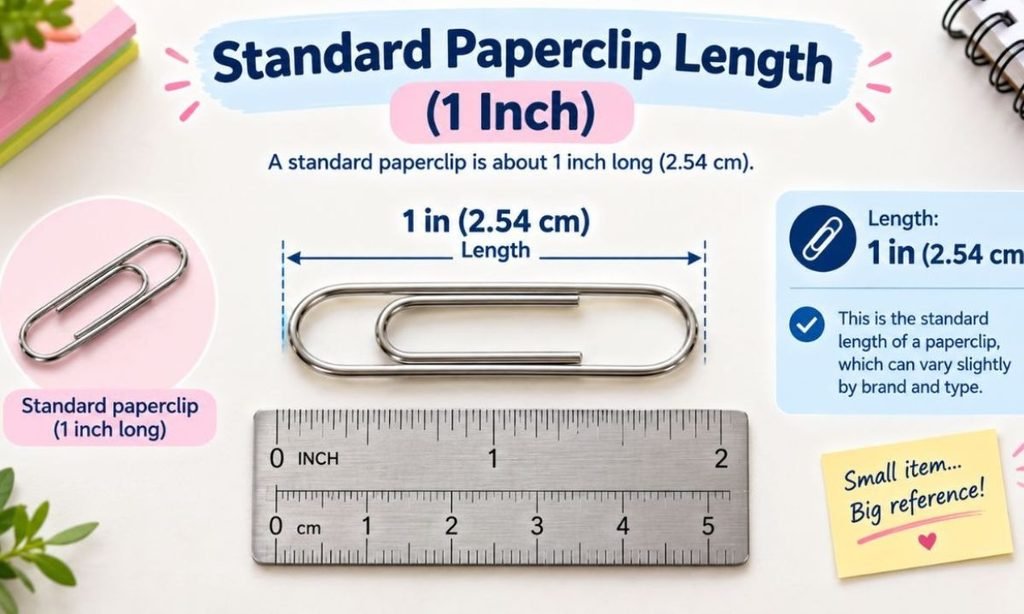
A regular-sized paperclip measures almost exactly 1 inch in length, making it one of the closest real-world matches available. It’s a go-to comparison because paperclips are found on nearly every desk, and their uniform manufacturing size keeps them consistent across brands.
Small Binder Clip Width Measurement
A small binder clip is typically about 3/4 inch to 1 inch wide, depending on the brand. It’s slightly smaller than a full inch in most cases, but close enough to serve as a quick visual reference when a paperclip isn’t handy.
Standard Postage Stamp Size (Square Style)
Many square-style postage stamps measure close to 1 inch on each side. While rectangular stamps vary slightly, square commemorative stamps are often manufactured near this size, making them a useful mental benchmark.
Standard Eraser Thickness in Inches
A pencil-top eraser or a standalone block eraser is often close to 1 inch in length or width, though thickness varies by brand. It’s a smaller, more subtle comparison, but still useful if you’re picturing thickness rather than length.
Kitchen and Household Objects That Measure 1 Inch
Household items offer some of the most accessible references, since they’re already sitting in most kitchens and drawers.
Wine Cork Diameter Size
A standard wine cork has a diameter of about 0.95 to 1 inch, making it one of the closest household matches to a true inch. It’s a handy comparison for anyone picturing round, cylindrical objects.
Bottle Cap Diameter Measurement
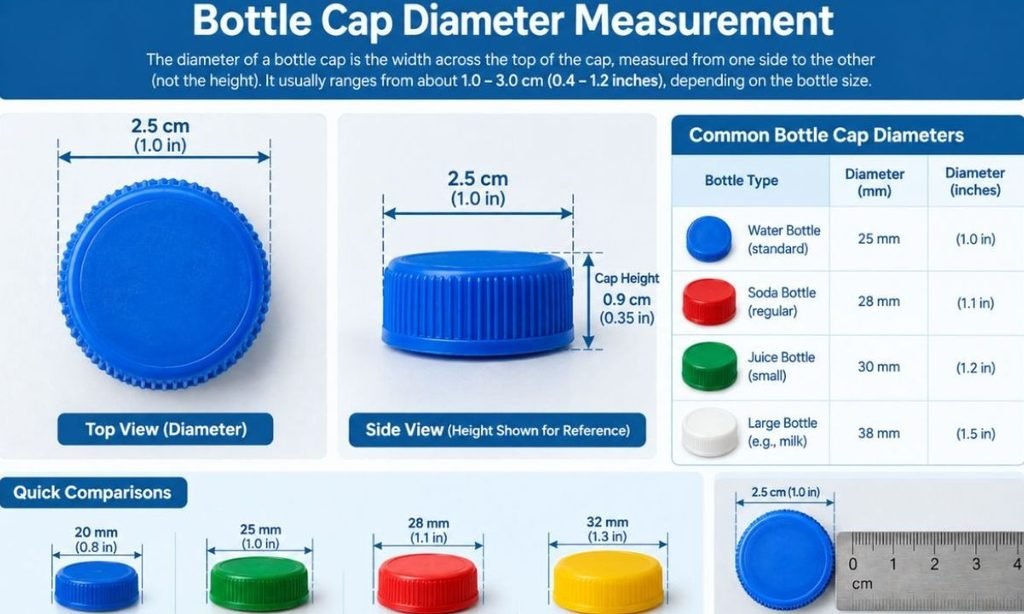
A typical bottle cap measures around 1.18 inches across, which is slightly larger than an inch but still a reasonably close visual reference. It’s a good example of an object that’s “close” rather than “exact.”
Small Button Diameter Reference
Small shirt buttons often measure close to 1/2 inch, while larger coat buttons can approach or exceed 1 inch. Button sizing varies significantly, so this comparison works best with larger buttons specifically.
| Household Item | Approximate Diameter | Comparison to 1 Inch |
| Wine cork | 0.95–1 in | Very close |
| Bottle cap | 1.18 in | Close |
| Large coat button | ~1 in | Very close |
| Small shirt button | ~0.5 in | Roughly half |
Coins and Currency as 1-Inch Measurement References
Coins are widely used as measuring references because they’re small, standardized, and available almost everywhere.
Quarter Coin Diameter (Nearly 1 Inch)
A US quarter has a diameter of 0.955 inches, making it one of the most reliable pocket-sized tools for estimating an inch. It’s not exact, but the difference is small enough that most people won’t notice without a precise measuring tool. This makes the quarter a favorite quick-reference for how long is 1 inch in a real, tangible object.
Technology and Electronic Items That Are 1 Inch Wide
Everyday electronics also offer useful size comparisons, particularly for width-based measurements.
AA Battery Diameter Size
An AA battery has a diameter of about 0.57 inches, which is roughly half an inch. It’s a helpful comparison for smaller measurements, though it falls short of a full inch on its own.
USB Flash Drive Width Measurement
Many standard USB flash drives measure close to 0.75 to 1 inch in width, depending on the model. Larger flash drives can meet or exceed the 1-inch mark, making them a reasonable everyday comparison.
SD Card Width Reference
A standard SD card measures approximately 0.94 inches wide, putting it very close to a full inch. It’s a compact, pocket-sized reference many people already carry in a camera bag or laptop.
Games, Toys, and Recreational Items Measuring 1 Inch
Toys and games often use standardized sizing, which makes them surprisingly accurate measurement tools.
LEGO Brick Height (3 Standard Bricks Stacked)
A single standard LEGO brick is about 0.38 inches tall (9.6 mm), so stacking approximately three bricks gets you close to 1 inch in total height. It’s a fun, hands-on way to visualize the measurement if you have a LEGO set nearby.
Chess Pawn Base Diameter
A standard chess pawn’s base often measures close to 1 inch in diameter, depending on the set size. Tournament-style sets tend to be more standardized, making the pawn base a decent visual reference.
Standard Dice Size (1 Inch Cube)
A classic six-sided die used in many board games measures exactly 1 inch on each side. This makes dice one of the most precise and widely available 1-inch references, since each side length matches the measurement exactly.
Personal Care and Body-Based 1-Inch References
When no object is available, your own body can serve as a surprisingly accurate measuring tool.
Adult Thumb Width as a Measuring Tool
The average adult thumb, measured across the base, is close to 1 inch wide. This is one of the most convenient references since it’s always available no searching for an object required.
Golf Tee Length Comparison
A standard golf tee measures about 2.125 inches in length, roughly double the length of 1 inch. It’s a useful comparison for visualizing what happens when you double the measurement.
Nature and Outdoor Items That Are 1 Inch in Size
Nature offers plenty of small-scale references, especially for anyone estimating size outdoors without tools.
Common Insect or Bug Sizes Near 1 Inch
Many common insects, such as large beetles or grasshoppers, measure close to 1 inch in body length. This comparison is especially useful for gardeners or anyone identifying insects by rough size.
Small Pebble or Stone Diameter
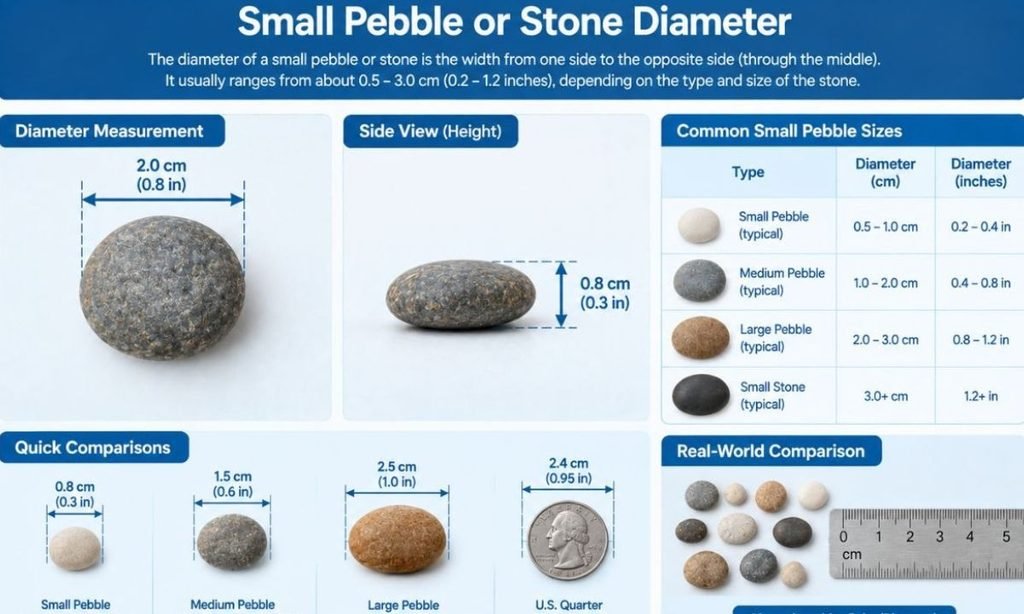
A small to medium pebble picked up outdoors often measures close to 1 inch across. Since pebble sizes vary widely, this comparison works best as a rough visual guide rather than a precise one.
How to Measure 1 Inch Without a Ruler
Not every situation calls for a tape measure, and knowing a few reliable shortcuts can save time when you need a rough estimate quickly.
Using Everyday Objects as Quick Reference Tools
Reaching for a quarter, a paperclip, or a standard die is one of the fastest ways to estimate 1 inch without any tools. These objects are widely available and close enough in size to give a dependable visual check.
Body-Based Measuring Techniques for Accuracy
Your thumb width, at its base, is one of the most consistent body-based tools for estimating an inch. While it varies slightly from person to person, it’s typically accurate enough for casual, non-precise tasks like DIY projects or quick furniture checks.
| Reference Object | Approximate Size | How It Helps |
| Quarter coin | 0.955 in | Fits in a pocket, always close to hand |
| Standard paperclip | 1 in | Nearly exact length match |
| Adult thumb width | ~1 in | Always available, no object needed |
| Standard die | 1 in per side | Precise cube reference |
These comparisons are approximate rather than exact in most cases, so for tasks requiring precision — like carpentry or tailoring — a ruler or tape measure is still the more reliable choice.
1 Inch vs. Similar Measurements
Seeing how 1 inch compares to nearby measurements can help put its size into better perspective.
| Measurement | Approximate Value | Difference |
| 1/2 inch | 0.5 in | Half the size of 1 inch |
| 1 inch | 2.54 cm | Reference point |
| 2 inches | 5.08 cm | Double the size of 1 inch |
Understanding these nearby measurements helps clarify just how small an inch really is, especially when compared to a foot (12 inches) or a full centimeter scale on a ruler.
Frequently Asked Questions About 1 Inch Measurements
How Many Centimeters Is 1 Inch Exactly?
1 inch is exactly 2.54 centimeters. This conversion is fixed and doesn’t change or round differently depending on the country or standard used.
Is a Quarter Coin Exactly 1 Inch?
Not exactly a US quarter measures 0.955 inches in diameter, which is close to but slightly smaller than a full inch.
What Common Item Is Exactly 1 Inch?
A standard paperclip and a classic six-sided die are both very close to an exact 1-inch measurement, making them reliable everyday references.
How Thick Is 1 Inch in Everyday Terms?
1 inch is roughly as thick as a stack of about 8 to 10 standard credit cards, or close to the width of an adult thumb.
Can I Use My Finger to Measure 1 Inch?
Yes, the average adult thumb width at its base is close to 1 inch, making it a handy, always-available estimating tool.
What’s the Difference Between 1 Inch and 25mm?
1 inch equals 25.4 millimeters, so 25mm is very slightly smaller than a true inch the difference is only 0.4mm.
How Do I Visualize 1 Inch Quickly?
Picture a quarter coin, a standard paperclip, or the base of your thumb all three are close, easy-to-recall visual matches for 1 inch.
Are All Bottle Caps 1 Inch Wide?
Not all bottle caps are the same size, but many standard beverage bottle caps measure close to 1.18 inches, making them slightly larger than a true inch.
Conclusion
An inch may be a small unit of measurement, but it shows up everywhere once you start looking for it from the paperclip on your desk to the quarter in your pocket to the dice in your board game drawer.
As this guide shows, 1 inch equals 2.54 centimeters and lines up closely with objects like a standard paperclip, a wine cork, or the width of an adult thumb.
The easiest way to remember how long 1 inch is comes down to picturing one of these familiar objects rather than trying to memorize an abstract number.
The next time you need a quick estimate and don’t have a ruler nearby, reach for a quarter, a paperclip, or simply your own thumb all three will get you remarkably close to a true inch.