

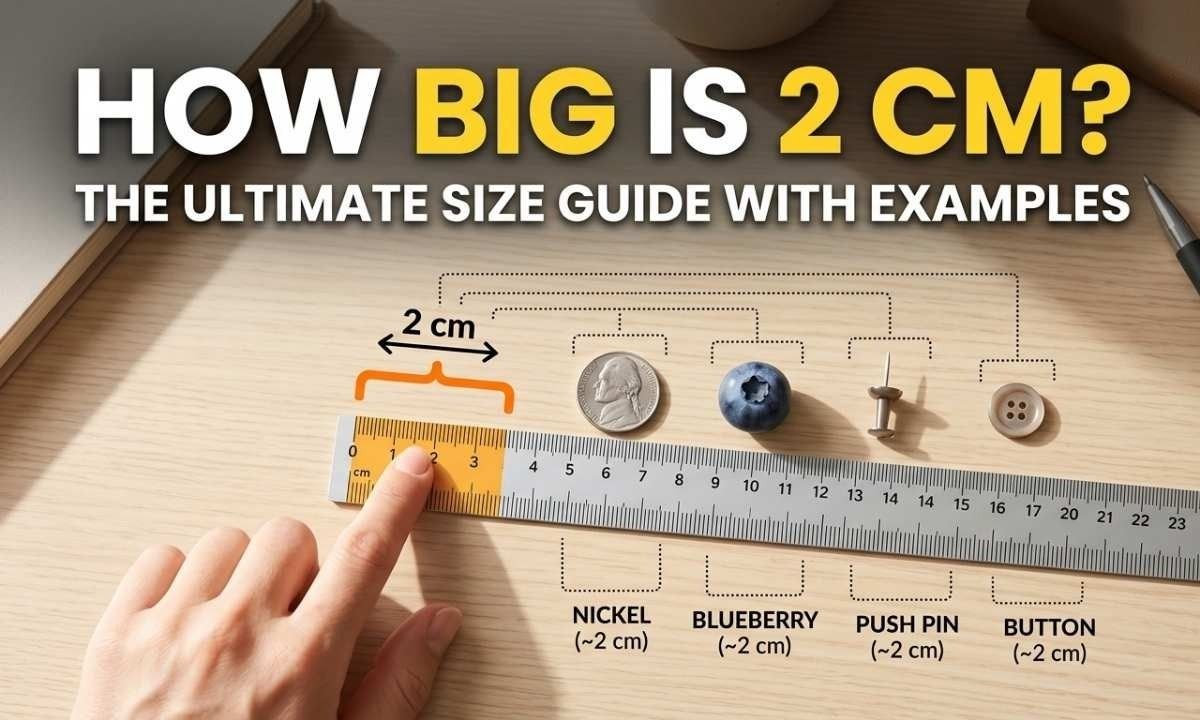
A length of 2 cm equals 20 millimeters, or about 0.79 inches. That is roughly the width of a US penny, a large grape, or an adult thumbnail.
It sounds tiny, but this size shows up everywhere. Jewelry listings, craft patterns, medical notes, and product specs all use it. Without a ruler, though, most people struggle to picture it.
This guide fixes that. You will see the different ways to write this measurement, a simple visual picture, 18 everyday objects, tricks to measure without a tool, and a clear conversion chart.
Different Ways to Write and Represent 2 cm
The same length can appear in many forms. Knowing them helps you read labels, forms, and recipes without confusion.
| Format | How It Is Written |
| Standard abbreviation | 2 cm |
| No space | 2cm |
| Full word | 2 centimeters (US) or 2 centimetres (UK) |
| Millimeters | 20 mm |
| Meters | 0.02 m |
| Scientific notation | 2 × 10⁻² m |
| Decimal inches | 0.787 in |
| Fractional inches | About 25/32 in |
Spelling matters a little. Americans write “centimeter,” while British and Australian writers use “centimetre.” Both mean the same thing.
You may also see it written as a range, such as “1.5 to 2.5 centimeters.” That means the item is not exactly 20 millimeters, but sits close to it.
Remember that the abbreviation “cm” has no period and no plural “s.” You write the number, a space, and then the two letters. Writing “cms” is a common slip, so skip it.
What Does 2 cm Look Like? A Simple Visual Guide
Picture a small coin. That is the quickest mental image.
A US penny is 19.05 millimeters wide, so it is just under 2 centimeters across. A US nickel is 21.21 millimeters, just over.
Here is a short visual guide to anchor the size:
- A thumbnail: For many adults, the width of the thumbnail is close to 2 centimeters.
- A large grape: Many grapes measure between 1.5 and 2.5 centimeters across.
- A penny: Just under 2 centimeters in diameter.
- A standard fingertip: The pad of a finger is often 1.5 to 2 centimeters wide.
- A sugar cube: Most cubes are roughly 1.5 to 2 centimeters on each side.
For comparison, a AA battery is about 1.45 centimeters in diameter. A US quarter is 2.43 centimeters. So this length sits between the two.
A good rule of thumb: it is about twice the width of a pea and about one fourth the short side of a credit card, which is 54 millimeters.
Size is easier to judge in two dimensions. A square of this size has sides of 20 millimeters, about the size of a small postage stamp’s printed image. A standard die is about 16 millimeters on each side, so a cube of this size is a little bigger than one.
People often overestimate small lengths and underestimate them in photos. A picture of a ring or a charm online can make it look large. Use a coin or your thumbnail as a mental stand-in to cut through that illusion.
On a ruler, find the metric edge. Count past the first numbered line to the second one. That second line marks it. Each small tick between numbers is a millimeter, so there are 20 ticks from zero.
18 Everyday Objects That Measure Approximately 2 cm
Real items vary by brand and style. Each entry notes the typical range so you can judge fairly.
1. A Standard Keyboard Keycap (Approximately 2 cm Wide)
Standard keys sit on a 19.05 millimeter grid, which is almost exactly 2 centimeters. The plastic cap itself is slightly smaller, near 18 millimeters. Look at any full-size keyboard to see the spacing.
2. A Small Binder Clip (Approximately 2 cm Wide)
The common small binder clip is 19 millimeters wide, or three quarters of an inch. That makes it a very close match. Smaller mini clips run about 15 millimeters.
3. A Size 1 Pharmaceutical Capsule (Approximately 2 cm Long)
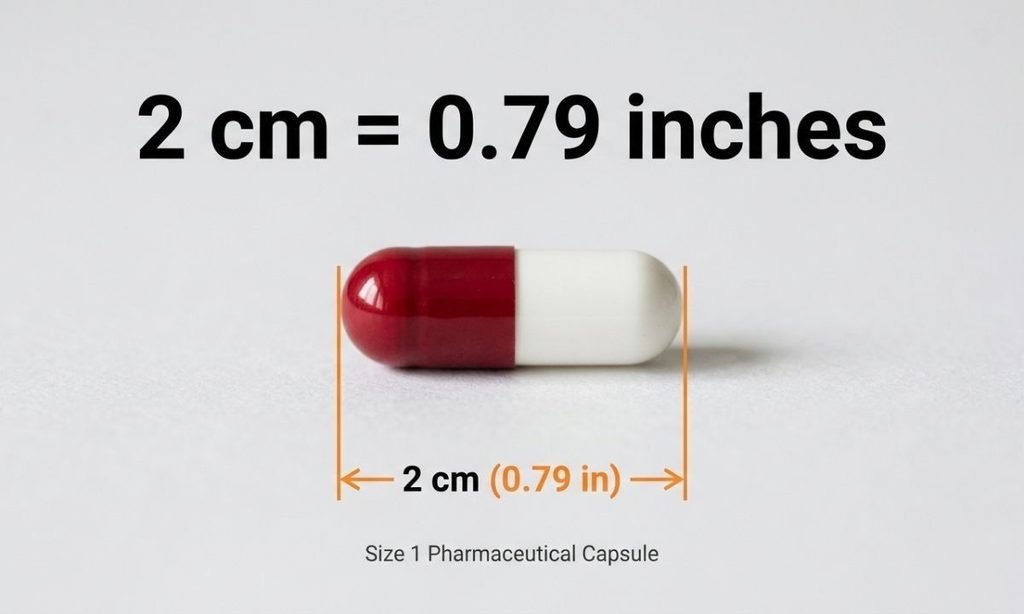
A size 1 capsule is about 19 millimeters long when closed. It is a smaller cousin of the more common size 0. Capsule sizes are standardized, so this one is reliable.
4. A Shirt Cuff Button (Approximately 2 cm in Diameter)
Dress shirt cuff buttons are usually about 10 to 12 millimeters. Larger sleeve buttons on blazers and coats run closer to 15 to 20 millimeters. Check the garment to see which size it carries.
5. A Small Square Candy (Approximately 2 cm Wide)
Many wrapped caramels, toffees, and chocolate squares measure around 2 centimeters per side. Brands differ, so treat it as an estimate. It makes a fun, edible reference.
6. A Watch Strap Lug (20 mm Wide)
Watch straps are sold by the width between the lugs, and 20 millimeters is one of the most popular sizes. It equals exactly 2 centimeters. Look at the size printed on the underside of a strap.
7. A Standard Domino Tile (Approximately 2 cm Thick or Wide, Depending on the Tile)
A standard double-six domino is often about 2 to 2.5 centimeters wide and around 1 centimeter thick. Mini sets run smaller. Measure your own set for the exact size.
8. A Fresh Broad Bean (Approximately 2 cm Wide)
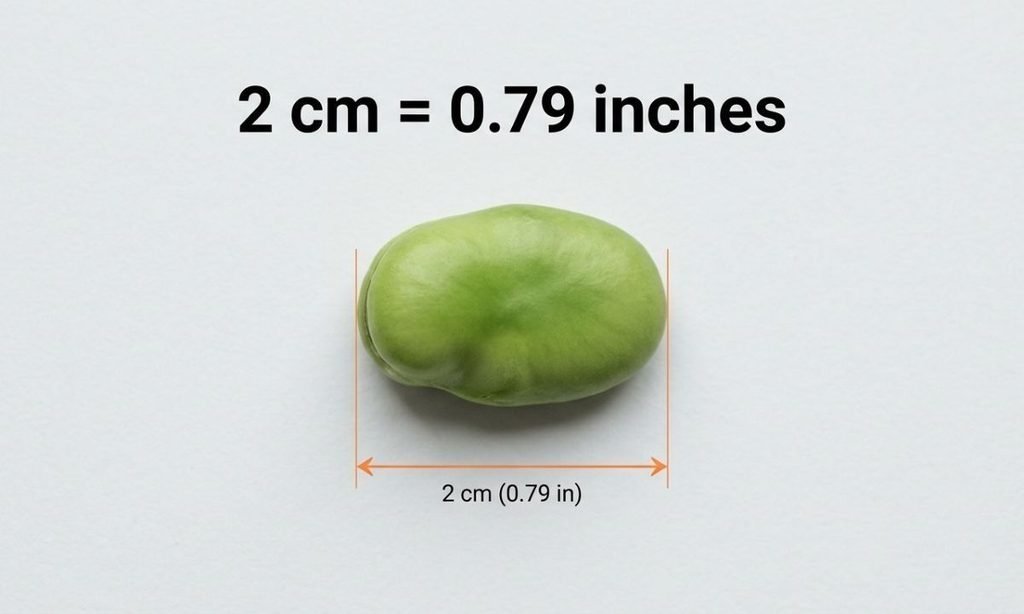
A shelled broad bean, also called a fava bean, is often 2 to 2.5 centimeters long and about 1.5 centimeters wide. The size depends on how mature it is. It is a handy kitchen reference when they are in season.
9. A Small Plastic Bottle Cap (Approximately 2 cm Wide)
A standard water bottle cap is closer to 2.8 to 3 centimeters across. Smaller caps from travel bottles, toothpaste tubes, and mini containers come near 2 centimeters. Pick a small one for the best match.
10. A Short Shirt Collar Stay (Approximately 2 cm Long)
Most collar stays are 4.5 to 7 centimeters long, with a width near 0.6 centimeters. The shortest versions made for small collars run around 3 centimeters. A 4-centimeter stay is about double the target size, so half of one is a quick guide.
11. A Small Pencil Eraser (Approximately 2 cm Long)
The eraser on the end of a standard pencil is about 1.5 to 2 centimeters long. Small block erasers often match the target. They are a handy desk reference.
12. A Small Hair Clip (Approximately 2 cm Wide)
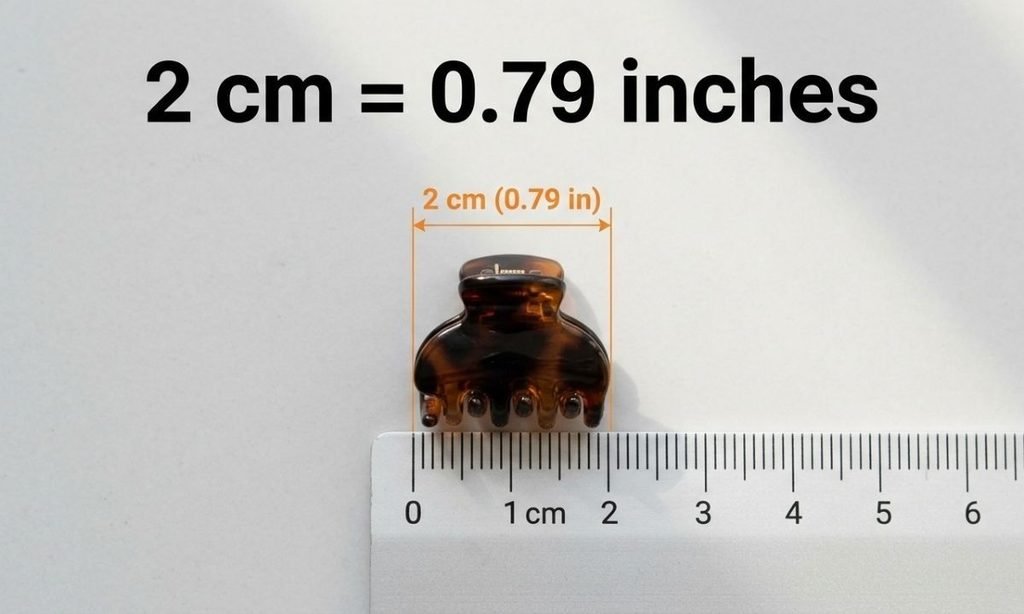
Mini hair clips and tiny claw clips often measure about 2 centimeters across the widest part. Full-size clips are much bigger, so choose a small one. Check the product details before you buy.
13. A Small Jewelry Bead (Approximately 2 cm in Diameter)
Beads are sold by millimeter size, and 20 millimeters is a popular large bead. It is chunky enough to be a statement piece on a necklace. Most beads in a craft kit are smaller.
14. A Small Paper Clip (Approximately 2 cm Long)
A regular paper clip is about 3 centimeters long. Mini clips run closer to 2 to 2.5 centimeters. Small ones are great for light stacks of paper.
15. A Shirt Button (Approximately 2 cm in Diameter)
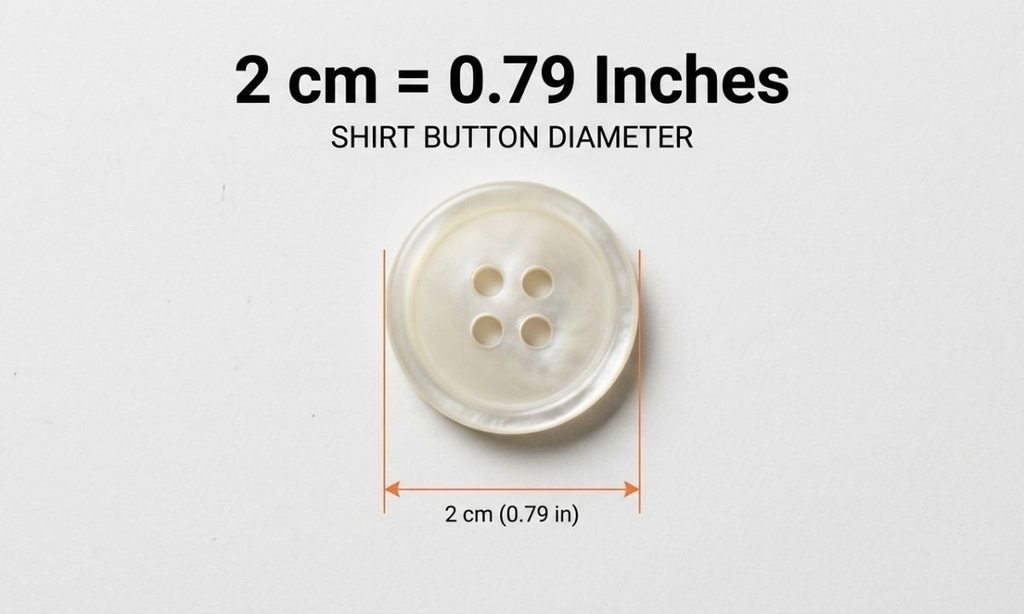
Most shirt buttons are around 1 to 1.2 centimeters. Larger buttons on cardigans and jackets reach about 2 centimeters. They are common on thick knitwear.
16. A Small USB Connector (Approximately 2 cm Wide)
The metal plug of a USB-A connector is about 1.2 centimeters wide. The plastic housing around it, on a flash drive or cable head, is often 1.5 to 2 centimeters wide. Measure the body, not the metal tip.
17. A Small Coin (Approximately 2 cm in Diameter)
A US penny is 19.05 millimeters. A euro 10 cent coin is 19.75 millimeters. Both are very close, so a handful of coins is the most reliable pocket reference.
18. A Small Craft Pom-Pom (Approximately 2 cm Wide)
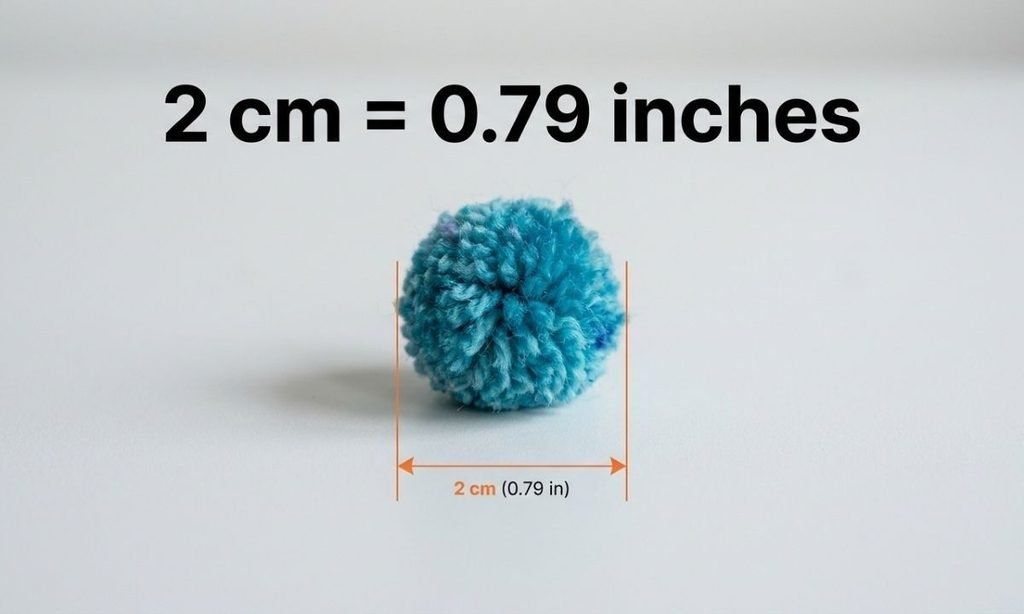
Craft pom-poms come in standard sizes, and 20 millimeters is common. They are soft and light. The bag usually prints the size on the label.
How to Measure 2 cm Without Using a Ruler
You can get close with items you already own. Try these simple methods.
- Use a penny. One US penny is 1.9 centimeters across. It is the closest coin.
- Use a nickel. It is 2.1 centimeters wide. Hold both coins and the target falls between them.
- Use masking tape. The common 19-millimeter roll is a tidy match.
- Fold paper. An A4 sheet is 21 centimeters wide. Fold it into ten equal strips and each is about 2.1 centimeters.
- Use graph paper. Count two large squares if they are 1 centimeter each.
- Use your thumbnail. Check the width once against a ruler so you know your own size.
For a quick check, place two coins side by side. A penny plus a dime equals about 3.7 centimeters, which is not what you want. Stick to the single-coin method.
If you need an accurate mark, trace a penny with a pencil and draw a small circle. Then use that circle as a stencil.
Always confirm with a real ruler when precision counts. Coins and body parts are only estimates.
One more option is a strip of ordinary paper. Mark the length once using a ruler, cut the strip, and keep it in your wallet or toolbox. You now own a custom gauge that never needs batteries. Make a second strip for half the size, which is 1 centimeter, and you can check both quickly.
How Big Is 2 cm Compared With Your Fingers or Hand?
Your body is a built-in measuring tool. Check each landmark once against a ruler, then you can use it any time.
On an average adult hand:
- Thumbnail width: Often 1.5 to 2 centimeters.
- Index fingernail width: Usually 1 to 1.5 centimeters.
- Pinky nail width: About 0.8 to 1 centimeter.
- Fingertip pad: Usually 1.5 to 2 centimeters wide.
- Thumb width at the top joint: About 2 to 2.5 centimeters.
Children’s hands are smaller, so these numbers will be lower. Adults with large hands may find that a thumbnail is closer to 2.2 centimeters.
Try this at home. Press your thumb onto a ruler and read the edges. Write the number on a sticky note and keep it for future reference.
What Is 2 cm in Inches, Millimeters, and Other Units?
Here is the fast reference. The conversion rests on a single fact: one inch equals exactly 2.54 centimeters.
| Unit | Value for 2 Centimeters |
| Millimeters | 20 mm |
| Meters | 0.02 m |
| Micrometers | 20,000 µm |
| Inches (decimal) | 0.7874 in |
| Inches (fraction) | About 25/32 in |
| Feet | 0.0656 ft |
| Points | 56.69 pt |
| Pixels (at 96 ppi) | 75.59 px |
| Pixels (at 72 ppi) | 56.69 px |
To convert on your own, use these formulas:
- Centimeters to inches: divide by 2.54
- Centimeters to millimeters: multiply by 10
- Centimeters to meters: divide by 100
So 2 ÷ 2.54 gives 0.7874 inches. That is a little over three quarters of an inch, so many people simply say “just under an inch.”
For a square, the area is 4 square centimeters, or about 0.62 square inches. For a cube, the volume is 8 cubic centimeters.
How to Measure 2 cm Using a Smartphone or Measuring App
Your phone can help when no ruler is around. There are three common approaches.
1. Use a built-in measuring tool. Many phones include an augmented-reality measuring app. Open it, point the camera at the object, and tap the start and end points.
2. Use a free ruler app. These show a virtual ruler on the screen. You place the object against the display and read the marks.
3. Use a calibrated screen ruler. Some apps let you calibrate with a credit card. A standard card is 85.6 millimeters wide, so the app can adjust its scale.
To get better results, follow these tips:
- Work in good light so the camera can see edges clearly.
- Keep the phone steady and parallel to the object.
- Measure on a flat, plain surface.
- Repeat the measurement two or three times and compare.
Accuracy has limits. Camera-based tools can be off by a few millimeters, which matters at this scale. A difference of 2 millimeters is a 10 percent error here.
So use an app for rough planning, and a physical ruler or caliper for anything you will cut, buy, or fit.
Everyday Situations Where a 2 cm Measurement Is Useful
You will meet this size in more places than you might expect.
- Jewelry and watches: Bead sizes, pendants, and strap widths are given in millimeters, and 20 is a common one.
- Sewing and crafts: Hems, seam allowances, buttons, and pom-poms often use this length.
- Cooking: Many recipes ask you to cut vegetables or dough into pieces about this size.
- Gardening: Planting depth and seed spacing are often given in centimeters.
- Home projects: Gaps for trim, shelf pin holes, and cable clearances are measured this way.
- Electronics: Connectors, chips, and cable heads are sized in millimeters.
- Medicine: Doctors record the size of cysts, wounds, and lumps in centimeters. If you notice a change, ask a clinician to measure it.
- Photography and printing: Margins and border widths often use this length.
- 3D printing and design: Models and tolerances are set in millimeters, so 20 is easy to spot.
Online shopping may be the most common case. A listing might say a charm is “2 centimeters tall,” and you can picture a penny to know if it suits you.
Frequently Asked Questions
How big is 2 centimeters in inches?
Two centimeters equals about 0.79 inches. That is a little over three quarters of an inch.
Is 2 centimeters the same as 20 millimeters?
Yes. One centimeter has 10 millimeters, so 2 centimeters is exactly 20 millimeters.
What coin is closest to 2 centimeters?
The US penny is the closest, at 19.05 millimeters. The nickel is slightly larger at 21.21 millimeters.
What is 2 centimeters about the size of?
It is about the size of a penny, a large grape, or a thumbnail. A sugar cube is similar.
How can I measure 2 centimeters without a ruler?
Use a US penny or a thumbnail checked against a ruler once. A strip of masking tape also works.
How many centimeters are in an inch?
There are exactly 2.54 centimeters in one inch. So 2 centimeters is just under an inch.
Is 2 centimeters bigger than 1 inch?
No. One inch is 2.54 centimeters, so 2 centimeters is smaller.
How big is 2 centimeters on a ruler?
It is the second numbered line on the metric edge. That is 20 small millimeter ticks from zero.
How big is 2 centimeters in pixels?
At 96 pixels per inch, it is about 75.6 pixels. At 72 pixels per inch, it is about 56.7 pixels.
Conclusion
Now you have a clear picture of this small but common size. It is 20 millimeters, or about 0.79 inches. Think of a penny, a thumbnail, or a large grape, and you are close.
Use the conversion table for quick answers, the coin and paper tricks when no ruler is around, and a real ruler when accuracy matters.
Save this guide for the next time a product listing, craft pattern, or medical note gives you a measurement in centimeters.