

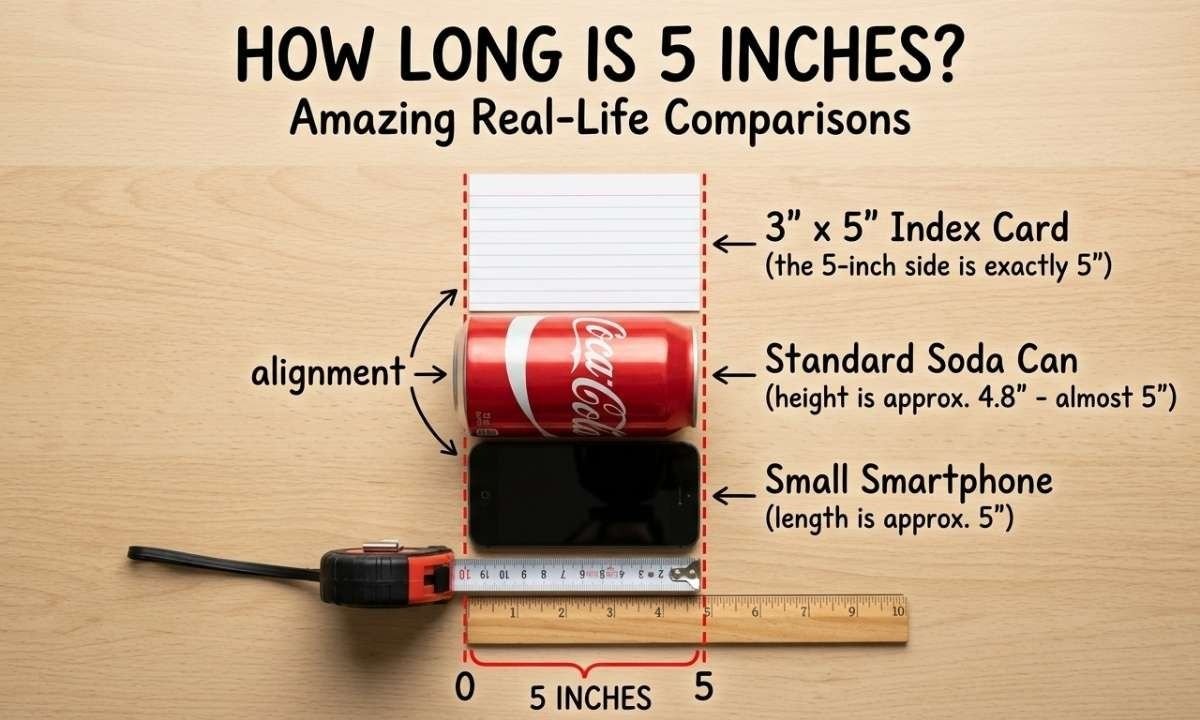
How long is 5 inches? It is exactly 12.7 centimeters, or 127 millimeters, which is a little less than half the length of a standard 12-inch ruler. That sounds simple on paper, but most people struggle to picture it without a measuring tool nearby.
This guide fixes that. You will see the exact conversions, hand-based comparisons, a quick reference chart, and 18 everyday items you can use as a visual guide. You will also learn how to measure 5 inches with your phone, household objects, or nothing at all.
By the end, you will be able to spot a five-inch length in seconds. That helps when you shop online, sew, craft, plan a project, or check a product listing.
What Is the Exact Length of 5 Inches?
How long is 5 inches in other units? It equals 12.7 centimeters, 0.4167 feet, or about 0.139 yards. In the metric system, that is 0.127 meters.
The inch is a unit of length used in the United States customary system and the British imperial system. Since 1959, one inch has been defined as exactly 2.54 centimeters.
So the conversion for five inches never changes, no matter which country you are in.If you only need the short answer to how long is 5 inches, here it is:
- 5 inches = 12.7 cm
- 5 inches = 127 mm
- 5 inches = 0.4167 feet
On a standard ruler, five inches sits just past the halfway point between the 4-inch and 6-inch marks. It is slightly shorter than half a foot, because half a foot is six inches.
How Many Centimeters and Millimeters Are in 5 Inches?
How long is 5 inches in metric? There are 12.7 centimeters and 127 millimeters in 5 inches. To get there, multiply the inch value by 2.54 for centimeters. Multiply again by 10 to reach millimeters.
The math looks like this:
- 5 × 2.54 = 12.7 centimeters
- 12.7 × 10 = 127 millimeters
Metric rulers often print only centimeters, so you will usually find the five-inch point between the 12 cm and 13 cm lines. It sits at the seventh millimeter tick after 12 cm.
If a product listing says 13 cm, it is just a touch longer than five inches. If it says 12 cm, it is slightly shorter. A listing of 10 cm falls well short, at roughly four inches.
A handy mental shortcut helps here. Think of 2.5 cm as one inch for rough work. That gives you 12.5 cm for five inches, which is close enough for quick estimates.
What Does 5 Inches Look Like in Real Life?
How long is 5 inches when you see it in real life? It looks like a short, compact length. Think of a small smartphone, a sharpened pencil that has been used for a few weeks, or a standard index card turned sideways.
It is longer than a credit card and shorter than a dollar bill.Two comparisons make it easy to remember. A credit card is about 3.4 inches long, so five inches is roughly one and a half credit cards laid end to end.
A standard 12-ounce soda can stands about 4.8 inches tall. That is almost exactly five inches, and most people have one within reach. It is a very reliable mental picture.
Another helpful image is a business card. Those measure about 3.5 inches wide, so five inches is a business card plus another inch and a half.
How Does 5 Inches Look When Compared to Your Hand?
Your hand is the most convenient way to judge how long is 5 inches, but it varies from person to person.
Before you rely on it, measure a few parts of your own hand once and remember them.Here are some common reference points:
- Palm width: Most adults have a palm about 3 to 4 inches across, measured at the knuckles.
- Thumb: The thumb from tip to the first big joint is often close to an inch.
- Index finger: Many adults have an index finger around 2.5 to 3 inches long.
- Hand span: The distance from thumb tip to little finger tip, stretched wide, is usually 7 to 9 inches.
Because hands differ, treat these numbers as starting points. A good trick is to find the part of your hand that lands closest to five inches.
For many people, it is the distance from the wrist crease to the base of the fingers, or a palm plus a thumb.
Once you know your personal answer to how long is 5 inches on your hand, you can estimate lengths anywhere. Check it against a ruler once, and you are set.
Is 5 Inches Big or Small? A Simple Size Comparison
How long is 5 inches, really? It depends on the object, but it is small for most everyday items without being tiny.
For a phone screen, five inches was once the standard flagship size. Today it feels compact. For a kitchen knife, it is a small paring blade.
For a houseplant pot, five inches is a starter size that suits herbs and small succulents.For a wrench or a screwdriver, it is on the short side.
In contrast, five inches can feel huge when it comes to certain things. A five-inch rainfall in a day is heavy.
A five-inch hailstone would be dangerous. A five-inch gap under a door is wide enough for a cat.Here is a simple size scale:
| Length | Size feel | Example |
| 1 inch | Tiny | A paper clip’s width |
| 3 inches | Small | A business card’s width |
| 5 inches | Compact | A soda can’s height |
| 8 inches | Medium | A standard pencil, nearly |
| 12 inches | Standard | A school ruler |
5-Inch Measurement Conversion and Quick Reference Chart
A chart saves time when you need to see how long is 5 inches in different units. Bookmark this section if you work with both metric and US measurements.
| Unit | Value for 5 inches |
| Millimeters | 127 mm |
| Centimeters | 12.7 cm |
| Meters | 0.127 m |
| Feet | 0.4167 ft |
| Yards | 0.1389 yd |
| Fractions of an inch | 5 inches, or 80/16 |
| Decimal inches | 5.00 in |
Here are a few neighboring values that people often look up next to five inches:
| Inches | Centimeters |
| 4 in | 10.16 cm |
| 4.5 in | 11.43 cm |
| 5 in | 12.7 cm |
| 5.5 in | 13.97 cm |
| 6 in | 15.24 cm |
Notice that every half inch adds 1.27 cm. This pattern helps you check your own conversions quickly.
How Does 5 Inches Compare to a Ruler or Measuring Tape?
On a ruler, how long is 5 inches? It is the fifth full numbered line from the zero edge. On a metric ruler, it falls at 12.7 cm. If your ruler has both scales, the five-inch mark sits a little to the right of the 12 cm line.
Reading a tape measure takes a little more care. The longest lines mark whole inches. The next longest mark is half inches, then quarters, eighths, and sixteenths.
Five inches is simply the line labeled 5, with no extra marks past it. If you are slightly over, count the small lines. Each small line on a standard tape is one sixteenth of an inch.
For example, 5 and 3/8 inches is six small lines past the 5. That is a common reading in woodworking and sewing.
Tape measures are flexible, so keep the tape straight and flat against the surface. A sagging tape adds error. A bent ruler does too.
18 Everyday Objects That Are Approximately 5 Inches Long
Visual references show how long is 5 inches better than numbers do for most people. The items below are either close to five inches in their common form or easy to cut or mark to five inches.
Where a product usually comes in a different size, the section says so.
1. A 5-Inch Index Card
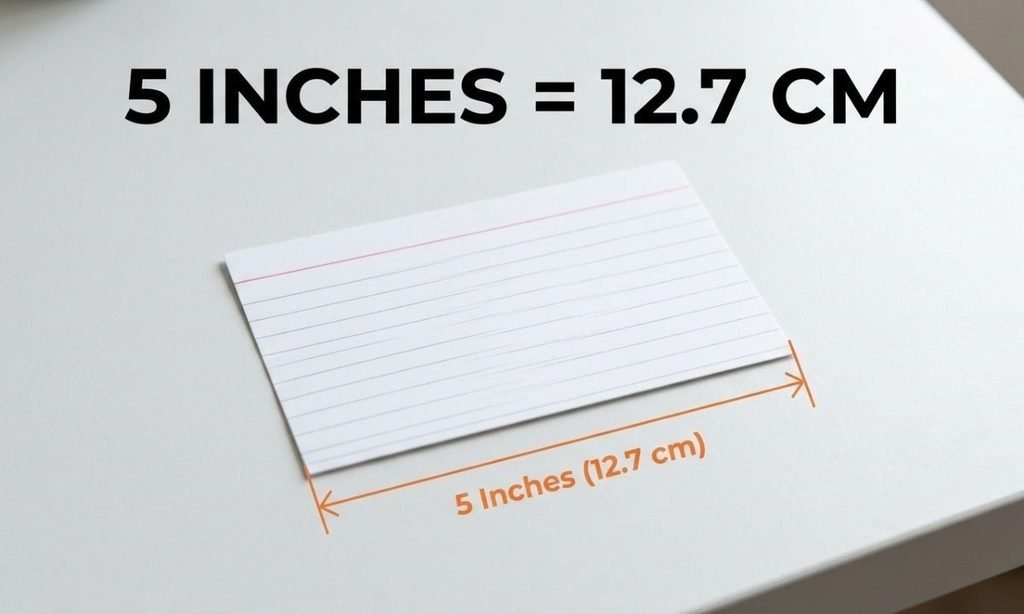
The classic 3 by 5 index card is one of the easiest ways to see how long is 5 inches. Its long side is exactly five inches. Hold one sideways and you have a ready ruler.
Index cards are cheap, flat, and easy to find in any office or classroom. They also fit in a wallet or notebook. If you need to check a length on the go, a card works well.
2. A 5-Inch Ruler Segment
Take any standard ruler and look at the first five inches from the zero edge. That stretch is your five-inch reference. Mark it with a pen or a small piece of tape if you use it often.
Rulers also help you see how fine the divisions are. Between each inch, you will find eight or sixteen small lines. Five inches is the cleanest number to practice with.
3. A 5-Inch Craft Stick
Standard craft sticks are about 4.5 inches long, and jumbo ones are about 6 inches. Neither is exactly five inches, but a standard stick is close. You can also trim a jumbo stick to five inches with a craft knife or small saw.
Craft sticks are popular for school projects and small models. Because they are cheap and light, they make a great hands-on measuring guide for kids.
4. A 5-Inch Wooden Dowel
Wooden dowels come in long lengths, usually 36 or 48 inches. Cutting one to five inches creates a sturdy reference. Sand the ends so they are flat and smooth.
Short dowel pieces are used for furniture joints, craft frames, and plant markers. If you build or repair things, a five-inch dowel piece is a common cut length.
5. A 5-Inch Piece of Ribbon
Ribbon is easy to cut and easy to see. A five-inch piece is a good length for small bows, gift tags, and hair clips. It is also about the length of a bookmark tail.
Measure from the end and cut cleanly. Satin ribbon frays quickly, so seal the ends with a small flame or fray stopper if you plan to keep it.
6. A 5-Inch Strip of Paper
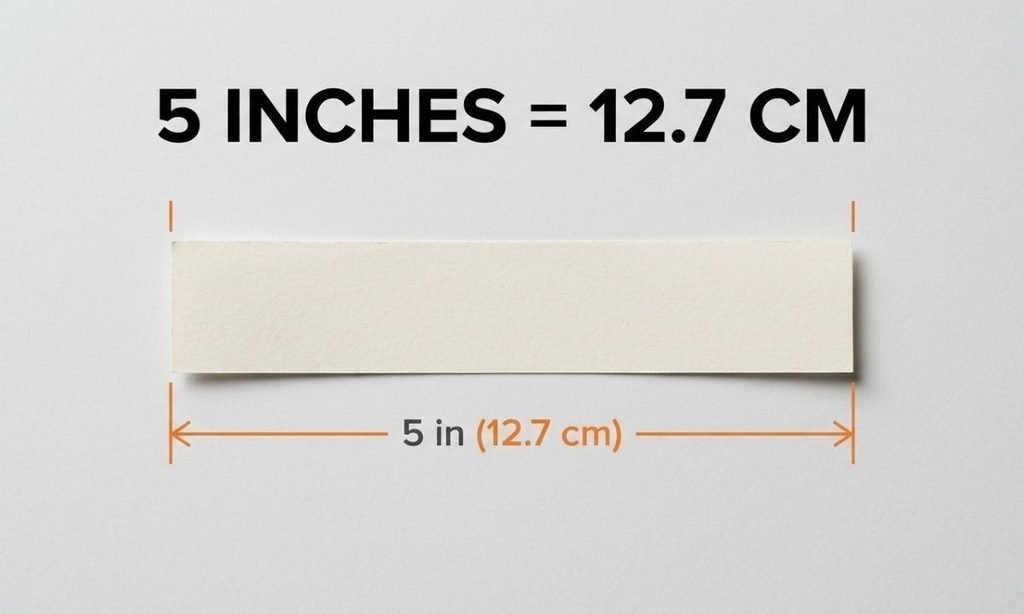
Cut a strip of paper about one inch wide and five inches long, and you have a simple reusable guide. Standard letter paper is 8.5 by 11 inches, so five inches is a little over half the short side.
A paper strip is useful for quick checks. Fold it in half and you get 2.5 inches. Fold it again and you get 1.25 inches. That makes it a handy teaching tool.
7. A 5-Inch Piece of String
String is the most flexible way to measure curved or irregular shapes. Cut a five-inch piece, then lay it along the outline of whatever you are checking.
String stretches a little, so use a thin cotton or twine type that holds its length. Pull it straight but not tight, and compare against a ruler to confirm your length.
8. A 5-Inch Cardboard Strip
Cardboard from a shipping box is firm and free. Cut a strip five inches long and a half inch wide. It stays straight and does not bend easily.
Use it as a gauge for spacing in crafts, planting, or shelf setups. A rigid strip gives better results than a soft one when you need to compare many items.
9. A 5-Inch Sewing Pattern Piece
Sewing patterns often include small pieces, such as pocket guides, cuffs, and facings, that measure around five inches. Seam allowances and hem depths are also marked in inches.
If you sew, a five-inch gauge is a staple. Many sewists keep a small metal seam gauge, which has a sliding marker. Slide it to five inches and you have a repeatable guide.
10. A 5-Inch Piece of Yarn
Yarn is another soft, flexible reference. A five-inch piece is typical for tassels, fringe, and tails when weaving in ends. Knitters and crocheters often leave a five- to six-inch tail after finishing a piece.
Yarn can stretch, so measure it relaxed. Lay it flat on a ruler without pulling and trim to length.
11. A 5-Inch Pipe Section
A 5-Inch Wire Piece
Short pipe sections are common in plumbing, craft projects, and garden builds. A five-inch cut of PVC pipe is easy to mark and cut. It also makes a durable, reusable measuring block.
For safety, use a fine-tooth saw and wear eye protection when cutting. Deburr the edges so they are smooth to the touch.
12. A 5-Inch Craft Foam Strip
Craft foam sheets are light and easy to trim with scissors. A five-inch strip is handy for kids’ crafts, costume pieces, and seasonal decorations.
Foam can compress slightly, so lay it flat when you measure. It is also a good option for younger children, because it is safe and easy to handle.
13. A 5-Inch Wooden Craft Strip
Thin wooden strips, often called basswood or balsa strips, are used in model building and small repairs. Cutting one to five inches creates a stiff, accurate gauge.
These strips are lightweight and come in many widths. Sand the edges to avoid splinters, and mark the five-inch point with a fine pencil line for accuracy.
14. A 5-Inch Paper Bookmark
Many bookmarks are around two inches wide and six inches tall, though shorter ones exist. You can easily make a five-inch version from cardstock. It is a fun project and a practical ruler at the same time.
Print or draw inch marks along one edge and you have a bookmark that doubles as a mini ruler. It is a thoughtful, low-cost gift too.
15. A 5-Inch Wire Piece
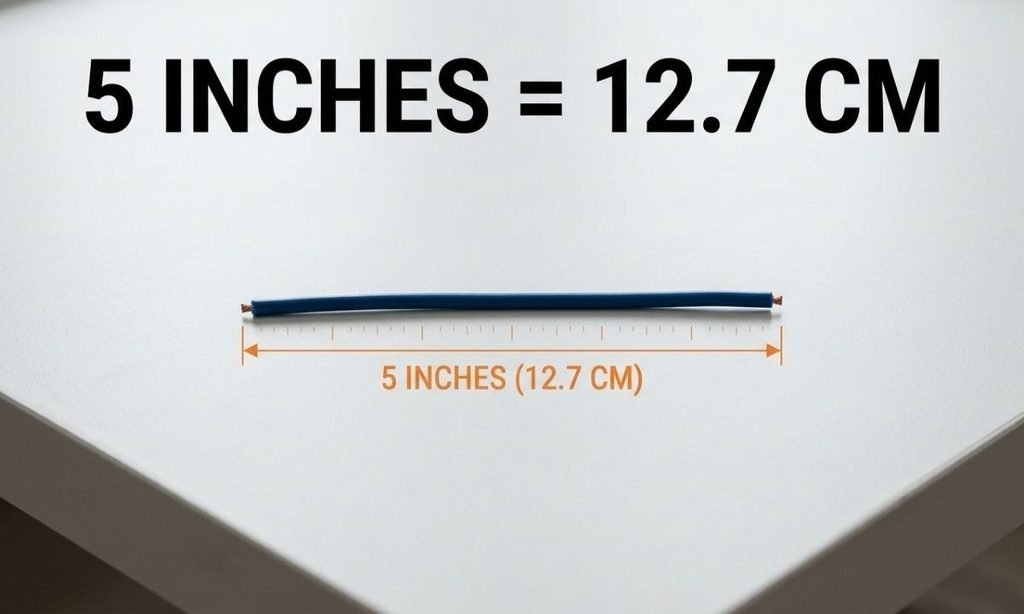
Thin craft wire is used in jewelry, floral work, and hobby builds. A five-inch length is typical for making small earring hooks, pins, and stems.
Straighten the wire before you measure, since curves make it look shorter. Use flush cutters for a clean edge, and file or fold over sharp ends before handling.
16. A 5-Inch Plastic Strip
Plastic strips cut from old packaging, sheet plastic, or flat plastic rulers hold their shape well. A five-inch strip is waterproof, which makes it useful in garden labeling and kitchen tasks.
Be careful when cutting hard plastic. Score it with a utility knife and snap along the line, or use sturdy scissors for thinner pieces.
17. A 5-Inch Clay Cylinder
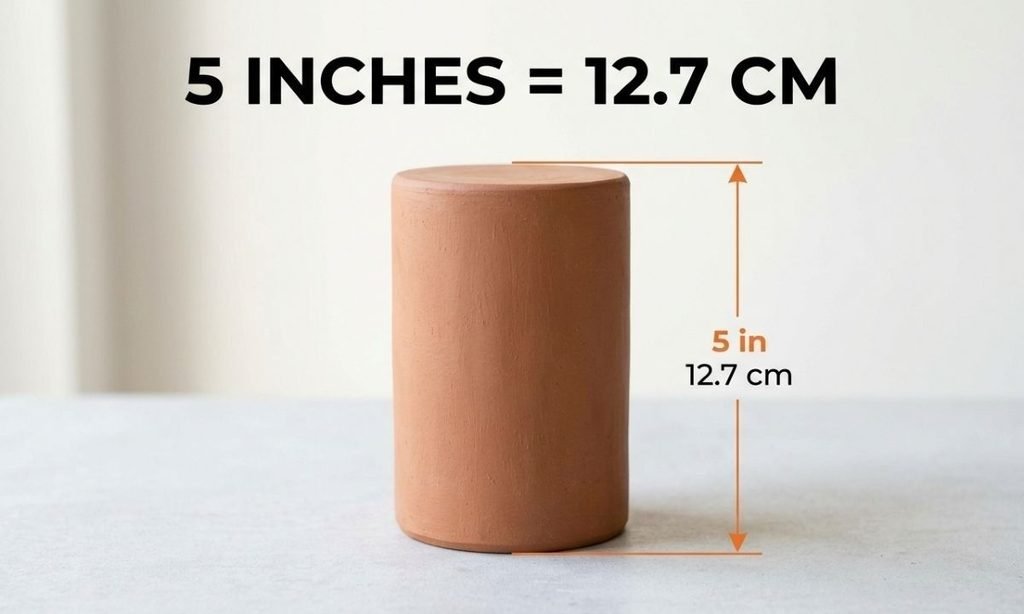
Roll modeling clay or polymer clay into a cylinder about five inches long. It is a useful hands-on example for children and a solid reference for sculptors.
You can press a ruler beside it to check the length. If the clay gets too long, trim it with a plastic blade. Bake or air-dry it if you want a permanent measuring piece.
18. A 5-Inch Fabric Strip
Fabric strips are common in quilting, patchwork, and crafting. A five-inch square, often called a charm square, is one of the most popular quilting sizes. Its sides are exactly five inches.
If you quilt, you already know the length well. Charm squares are sold in packs and make an excellent portable five-inch guide.
Everyday Household Materials You Can Use to Estimate 5 Inches
You do not need special tools to learn how long is 5 inches. A few common household items are close enough for everyday estimates.
Check each against a ruler once, and remember which ones fit best.Here are some good options:
- 12-ounce soda can: About 4.8 inches tall, so it is slightly under five inches.
- Credit or debit card: About 3.4 inches long. Add half the card again, and you are near five inches.
- US dollar bill: About 6.1 inches long. Fold off about an inch to get close to five.
- Standard index card: Five inches along the long side.
- Sharpened pencil: New ones are about 7.5 inches, so a well-used one is often near five.
- Large paper clip: Jumbo clips are about 2 inches, so two and a half make five inches.
- Smartphone: Older compact models are close to five inches tall. Many newer ones are longer.
A tip for accuracy: always measure on a flat, hard surface. Make sure the item is not curved or bent. A soft or flexible item can read short if it is not pulled straight.
How to Measure 5 Inches Using Your Phone or Household Items
Phones are useful measuring tools, and most people carry one all day. Here is how to check how long is 5 inches with yours.
Follow these steps:
- Open the built-in measuring app, which is available on many smartphones, or download a trusted ruler app.
- Place your phone on a flat surface and point the camera at the start of the object.
- Tap to set a starting point, then move the camera along the object until the display reads five inches.
- Tap again to set an endpoint, and check the reading.
Camera-based tools use augmented reality and can drift, especially in dim light. For reliable results, hold your phone steady and measure slowly. Check the result against a card or ruler if it matters.
You can also use your phone as a physical guide. Many phones have a screen length close to five or six inches, but that varies. Look up your model’s dimensions online and note the length of the body or the screen.
A reliable trick uses a credit card for calibration. Cards are a standard size of 3.37 by 2.125 inches. Place one beside your phone’s on-screen ruler to check that the scale is accurate.
If you have a printer, you can print a ruler at 100 percent scale. Make sure the print setting is set to actual size, not fit to page. Then measure the printed ruler against a real one to confirm it.
Simple Ways to Measure 5 Inches Without Using a Ruler
Sometimes there is no ruler, no phone, and no tape. These simple tricks show how long is 5 inches anyway.
- Use an index card. Its long side is exactly five inches.
- Stack coins. A US quarter is about 0.96 inches wide, so five quarters in a row measure about 4.8 inches. Add a little extra for five inches.
- Use your hand. Measure your palm and fingers once against a ruler. Remember the part that equals five inches.
- Use a soda can. It is about 4.8 inches tall, which is very close.
For better accuracy, combine two methods. Check your hand against a can, then check the can against a card. Matching results mean your estimate is reliable.
Why Understanding a 5-Inch Measurement Is Useful
Knowing how long is 5 inches helps in many daily situations. It is a very common size across products, crafts, and home projects.
Here are some of the places it matters:
- Online shopping: Product pages often list sizes in inches. Picturing five inches helps you decide if a wallet, a phone case, or a tool will fit.
- Sewing and quilting: Seam allowances, hem depths, and charm squares often use five-inch measures.
- Gardening: Many seeds, bulbs, and starter pots need holes or pots about five inches deep.
- Home repair: Screws, bolts, and hardware vary in length. A five-inch fastener is a common size for decks and framing.
- Crafts and school projects: Teachers and parents use five-inch examples to teach length and estimation.
- Cooking: Small knives, spoons, and ramekins are often close to five inches.
It also builds a sense of scale. When you can picture how long is 5 inches, you can judge six, eight, or ten inches more easily. That kind of spatial awareness saves time and prevents mistakes.
In short, knowing how long is 5 inches makes everyday decisions faster and more accurate.
Frequently Asked Questions
How long is 5 inches in cm?
Five inches equals 12.7 centimeters. Multiply the inch value by 2.54 to get the answer.
How long is 5 inches in mm?
Five inches equals 127 millimeters. It is 12.7 cm multiplied by 10.
How long is 5 inches compared to half a foot?
It is one inch shorter, because half a foot is six inches.
What household item is about 5 inches long?
A 12-ounce soda can is about 4.8 inches tall, and a 3 by 5 index card is exactly five inches along its long side.
How many feet is 5 inches?
Five inches is about 0.4167 feet, or roughly five twelfths of a foot.
Is a quarter 5 inches long?
No. A US quarter is only about 0.96 inches wide, so you would need about five of them in a row to get close to five inches.
How do I measure 5 inches without a ruler?
Use a 3 by 5 index card, a soda can, or a palm-and-thumb length you have already checked against a ruler.
Is 5 inches a large size for a phone?
No. Five inches is compact by current standards, because most modern phones are larger than that.
How can I convert inches to centimeters quickly?
Multiply the inches by 2.54. For a fast estimate, multiply by 2.5.
Conclusion
Five inches is 12.7 centimeters, 127 millimeters, or about 0.42 feet. It is a compact, easy-to-visualize length once you link it to a few familiar items, such as an index card, a soda can, or a spot on your hand.
Now you know how long is 5 inches in both metric and US units, and you have 18 everyday comparisons to back it up. Use the chart when you need a quick conversion, and use the tricks above when you have no tools at all.
The next time you wonder how long is 5 inches on a product page, a pattern, or a plan, you will know exactly what to expect. Keep an index card handy, and you will always have an accurate guide.