

If you’ve ever picked up a brick and been surprised by how heavy it felt, you’re not alone. Knowing how much does a brick weigh matters for anyone planning a construction project, ordering materials, or simply curious about the everyday objects around them. Bricks may look small and uniform,
but their weight can vary quite a bit depending on the material, size, and whether they’re solid or hollow. In simple terms, a brick’s weight is determined by three things: the material it’s made from (clay, concrete, or another composite), its dimensions, and whether it has holes or cavities inside it. A standard red clay brick generally weighs a few pounds,
while a concrete block can weigh several times more. Understanding these differences helps you avoid guesswork when estimating loads, shipping costs, or wall weight.
This article covers everything you need to know about how much does a brick weigh, including conversions into grams, kilograms, and pounds, comparisons between clay and concrete bricks,
Quick Conversion / Measurement Reference
A standard modular clay brick weighs approximately 4.5 pounds, but this shifts depending on size and material. Here’s a quick snapshot of the average weight of a standard brick converted into common units.
| Unit | Value |
| Pounds (lb) | 4.5 lb |
| Kilograms (kg) | 2.04 kg |
| Grams (g) | 2,040 g |
| Ounces (oz) | 72 oz |
| Ounces (Troy, rare use) | ~65.6 oz t |
These figures represent a standard modular clay brick. Concrete bricks and blocks weigh more, sometimes two to four times as much, which is covered in later sections.
Quick Reference Table
To put brick weight into perspective, here’s how it compares with familiar everyday objects.
| Item | Approximate Weight | How Close to a Standard Brick |
| A liter bottle of water | 2.2 lb | Close |
| A standard bag of sugar | 4 lb | Very close |
| A large adult cat | 10 lb | Heavier |
| A gallon of milk | 8.6 lb | Heavier |
| A hardcover novel | 1.5 lb | Lighter |
| A laptop computer | 4–5 lb | Very close |
| A brick-sized loaf of bread | 1.5 lb | Lighter |
| A standard house brick (clay) | 4.5 lb | Exact |
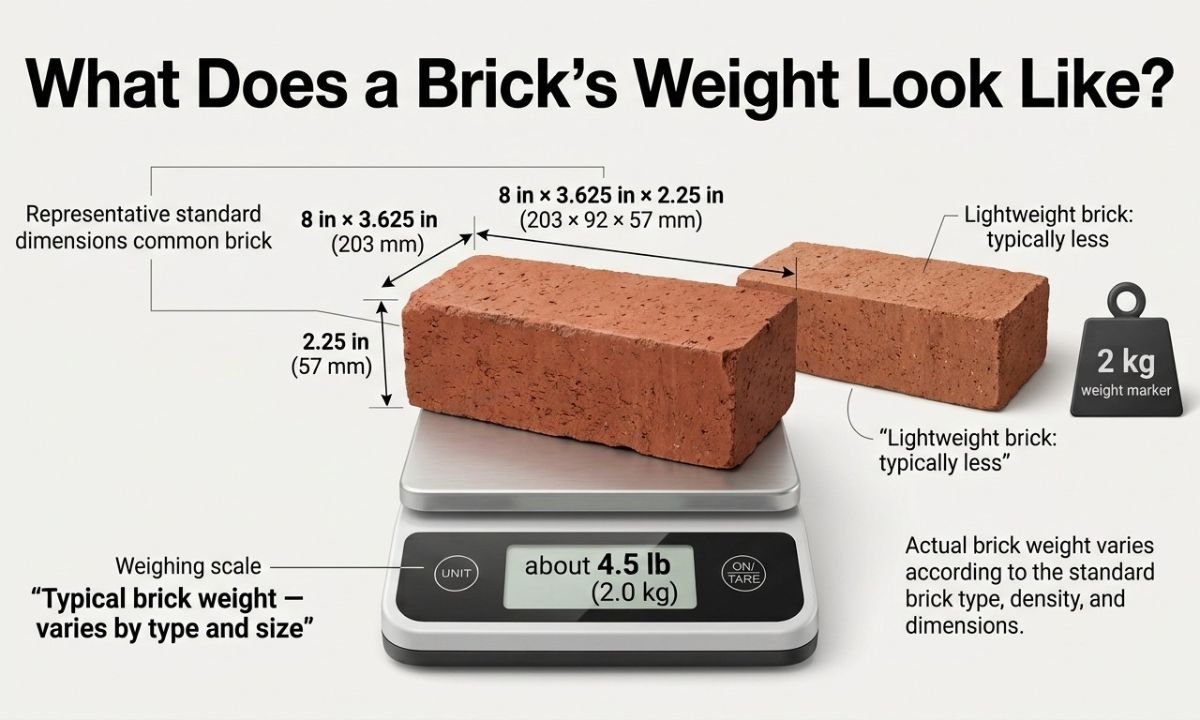
What Does a Brick’s Weight Look Like?
Picture holding a full bag of sugar in one hand that’s roughly what a standard clay brick feels like. It’s light enough to carry several at once but heavy enough that stacking hundreds of them adds up to serious weight fast
The Average Weight of Standard Red Bricks
The average weight of a standard red clay brick falls between 4 and 5 pounds, with most modern manufactured bricks landing close to 4.5 pounds. This weight reflects the density of fired clay and the typical modular size used in most residential construction.
Weight can shift slightly depending on the clay composition, firing temperature, and moisture content at the time of packaging. Bricks fired at higher temperatures tend to be denser and marginally heavier, while some softer clay bricks fall toward the lower end of the range.
How Many Grams Does a Brick Weigh?
In grams, a standard red brick weighs approximately 2,000 to 2,100 grams. This gram-based measurement is especially useful for anyone working with metric building specifications or comparing brick weight to smaller household items,
Brick Weight by Size and Dimensions
Brick weight is closely tied to its dimensions. Larger bricks naturally weigh more because they contain more material, while smaller or thinner bricks weigh proportionally less. Below is a breakdown of how different standard sizes affect overall weight.
| Brick Type | Typical Dimensions (L x W x H) | Approximate Weight |
| Modular | 7.625″ x 3.625″ x 2.25″ | 4.5 lb |
| Queen | 7.625″ x 3″ x 2.75″ | 5.5 lb |
| King | 9.625″ x 2.75″ x 2.75″ | 6.5 lb |
| Large-format | 11.625″ x 3.625″ x 3.625″ | 9–10 lb |
Modular, King and Queen Brick Weights
Modular bricks are the most common size used in residential walls, typically weighing around 4.5 pounds. Queen bricks are slightly longer and thicker, pushing their weight closer to 5.5 pounds.
King bricks, which are longer still, generally weigh between 6 and 6.5 pounds due to their extended length even though they’re often slimmer in width.
Large-Format Brick Weight
Large-format bricks are used in feature walls or modern architectural designs where fewer, bigger units are preferred. These bricks can weigh 9 to 10 pounds each, nearly double the weight of a standard modular brick, because of their significantly larger volume.
Clay Brick Weight Comparison
Comparing clay bricks side-by-side shows a clear pattern: weight increases steadily with size. A modular brick at 4.5 pounds sits at the lighter end, while large-format clay bricks at 9–10 pounds represent more than double that weight. This is important to factor in when estimating material costs, pallet counts, or the load-bearing needs of a wall.
Concrete Brick vs. Concrete Block Weights
Concrete bricks and blocks are noticeably heavier than clay bricks because concrete is denser and often used in larger, hollow-core units. A standard concrete brick typically weighs 8 to 9 pounds, while concrete blocks commonly called cinder blocks can weigh significantly more depending on their density.
How Much Does a Dense Concrete Block Weigh?
A dense concrete block, often used for foundation walls, typically weighs between 35 and 40 pounds. These blocks are solid and heavy-duty, designed for structural load-bearing applications rather than decorative facades.
Lightweight and Aircrete Block Weight
Lightweight and aircrete (autoclaved aerated concrete) blocks are engineered to weigh far less than standard dense blocks, usually around 15 to 20 pounds for a comparable size. Their internal air pockets reduce density significantly, making them easier to handle without sacrificing insulation performance.
Hollow vs. Solid Brick Weights
Whether a brick is hollow or solid has a major impact on its weight. Solid bricks are made of continuous material throughout, while hollow bricks have internal cavities designed to reduce weight, improve insulation, and cut material costs.
Solid Brick vs. Hollow Brick Weight Comparison
| Brick Type | Approximate Weight | Notes |
| Solid clay brick | 4.5–5 lb | Full material, no cavities |
| Hollow clay brick | 3–3.5 lb | 20–30% lighter than solid |
| Solid concrete brick | 8–9 lb | Dense and heavy |
| Hollow concrete block | 25–30 lb | Still heavier despite cavities due to size |
Hollow bricks can be 20 to 30 percent lighter than their solid counterparts of the same overall size, which makes a noticeable difference when transporting or lifting large quantities.
Thin Brick and Veneer Weights
Thin brick and brick veneer products are designed to mimic the look of full bricks without the bulk or weight, making them popular for interior accent walls and lightweight cladding.
How Much Does a Thin Brick Weigh?
A thin brick typically weighs between 1 and 1.5 pounds, since it’s usually only a half-inch to three-quarters of an inch thick. This is roughly a third of the weight of a standard full-size brick, making thin brick a practical choice where reducing structural load matters.
Specialty Bricks: Fire Bricks, Pavers and Roman Bricks
Specialty bricks are built for specific purposes, and their weight often reflects that specialized design. Fire bricks need to withstand extreme heat, pavers need to endure outdoor wear, and Roman bricks follow a distinct long, thin shape used in historical and decorative architecture.
Fire Brick and Paver Weight Comparison
| Specialty Brick | Approximate Weight |
| Fire brick | 7–9 lb |
| Concrete paver | 4–6 lb |
| Roman brick | 4–4.5 lb |
Fire bricks tend to be denser and heavier than standard bricks because they’re made from refractory materials designed to resist high temperatures. Pavers, used for patios and walkways, generally fall within a similar range to standard bricks, while Roman bricks are close in weight despite their longer, flatter shape.
How Much Does a LEGO Brick Weigh?
On the opposite end of the spectrum, a LEGO brick weighs a tiny fraction of a real construction brick. A standard 2×4 LEGO brick weighs approximately 2.5 grams, making it roughly 800 times lighter than a real clay brick.
LEGO Brick Weight by Size and Type
| LEGO Brick Type | Approximate Weight |
| 2×2 brick | ~1.2 g |
| 2×4 brick | ~2.5 g |
| 1×1 brick | ~0.4 g |
| 4×8 plate | ~5 g |
While playful, this comparison highlights just how much material and density separate a toy brick from a real building brick.
Calculating Brick Weight for Construction Projects
For anyone planning a build, knowing the total weight of the bricks needed helps with transportation planning, load calculations, and cost estimates. Multiplying the weight of a single brick by the total number required gives a rough total, but professionals often use simpler shortcuts.
The Bricks-per-Ton Rule
A common rule of thumb is that approximately 450 standard modular bricks make up one U.S. ton (2,000 lb), based on an average brick weight of around 4.5 pounds. This shortcut helps estimate how many pallets or truckloads are needed for a large order without weighing every single unit.
Brick Pallet Weight
A standard pallet typically holds 500 to 530 bricks and weighs approximately 2,250 to 2,400 pounds when loaded with standard modular bricks. This weight is important for anyone arranging delivery, since it affects what vehicle or equipment is needed to transport the pallet safely.
How Much Does a House of Bricks Weigh?
Scaling up from a single brick to an entire house reveals just how much weight is involved in brick construction. A typical brick-veneer home can use anywhere from 8,000 to 15,000 bricks depending on size and layout.
Estimating the Total Weight of a Brick House
Using the average brick weight of 4.5 pounds, a home built with 10,000 bricks would carry roughly 45,000 pounds, or about 22.5 tons, of brick alone not counting mortar, framing, or other structural materials. This is why foundation design accounts so carefully for brick veneer loads.
Why Brick Weight Matters
Brick weight isn’t just a curiosity it directly affects construction planning, shipping logistics, and even building design. Underestimating brick weight can lead to structural miscalculations, while overestimating can inflate transportation costs unnecessarily.
How Brick Weight Affects Transportation and Construction
Heavier bricks require sturdier pallets, more careful stacking, and vehicles rated for higher loads. On the construction side, wall weight influences foundation requirements, especially for veneer applications where the brick layer adds substantial dead load to the structure.
Measuring Brick Weight Without a Scale
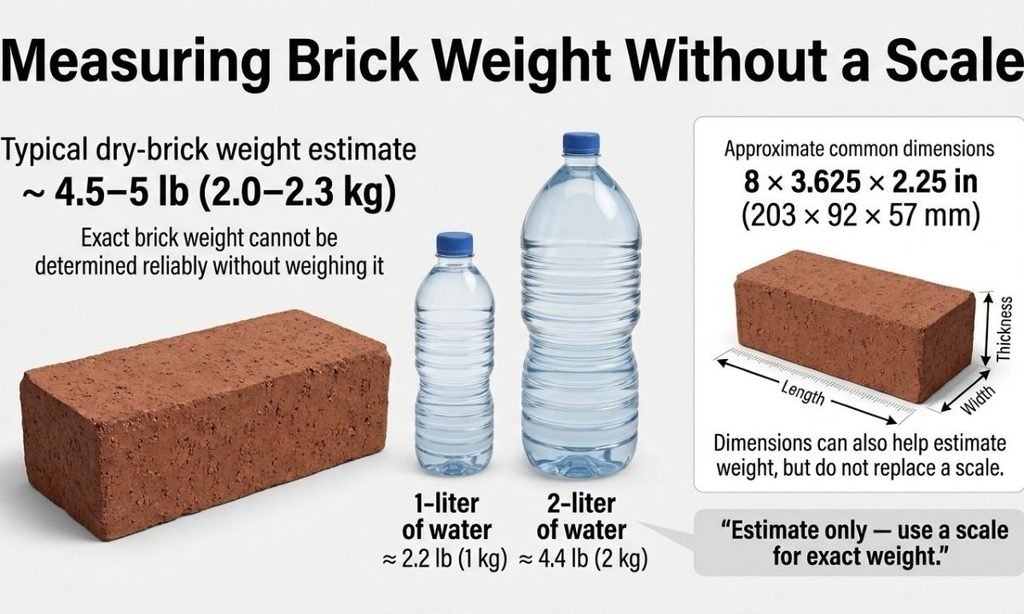
Not everyone has access to a scale when trying to estimate brick weight on-site or while shopping for materials. Fortunately, there are a few practical ways to approximate it using familiar objects.
Practical Comparison Table:
| Reference Object | Approximate Weight | How It Helps |
| A bag of sugar | 4 lb | Nearly identical to a modular brick |
| A full water bottle (1L) | 2.2 lb | Roughly half a brick’s weight |
| A laptop | 4–5 lb | Very close match for quick comparison |
| A gallon of paint | 10–11 lb | Comparable to two bricks combined |
These comparisons are approximate and meant for quick, practical estimation rather than precise measurement.
Brick Weight vs. Similar Measurements
Comparing brick weight to lighter and heavier building materials helps put it into perspective within the broader context of construction.
| Measurement | Approximate Value | Difference |
| Thin brick veneer | 1–1.5 lb | Lighter than standard brick |
| Standard clay brick | 4.5 lb | Reference point |
| Dense concrete block | 35–40 lb | Roughly 8x heavier |
This range shows just how much variation exists across brick and block types, reinforcing why it’s important to know exactly which type you’re working with before estimating totals.
Frequently Asked Questions
How Much Does a Brick Weigh in Kilograms?
A standard brick weighs approximately 2.04 kilograms, making it easy to convert for metric-based calculations.
Are Concrete Bricks Heavier Than Clay Bricks?
Yes, concrete bricks are generally heavier than clay bricks of similar size, often weighing 8 to 9 pounds compared to a clay brick’s 4.5 pounds.
How Much Does a Full Pallet of Bricks Weigh?
A full pallet of standard bricks typically weighs between 2,250 and 2,400 pounds, holding around 500 to 530 individual bricks.
Do Hollow Bricks Weigh Less Than Solid Bricks?
Yes, hollow bricks are typically 20 to 30 percent lighter than solid bricks of the same size because of their internal cavities.
How Much Does a Brick Weigh Compared to a LEGO Brick?
A real clay brick weighs around 2,040 grams, while a standard 2×4 LEGO brick weighs only about 2.5 grams nearly 800 times lighter.
How Many Bricks Make Up a Ton?
Approximately 450 standard modular bricks make up one U.S. ton, based on an average weight of 4.5 pounds per brick.
How Much Does a Brick House Weigh in Total?
A typical brick veneer home using around 10,000 bricks weighs roughly 45,000 pounds, or about 22.5 tons, in brick material alone.
Conclusion
Understanding how much does a brick weigh comes down to a few key factors: material, size, and whether the brick is solid or hollow.
A standard clay brick weighs around 4.5 pounds or 2.04 kilograms, while concrete bricks and blocks can weigh significantly more, and specialty options like thin brick or LEGO bricks sit at the lighter end of the scale.
Knowing these differences helps with everything from estimating pallet loads to planning a full construction project.The easiest way to visualize brick weight is to think of a standard bag of sugar in your hand that’s almost exactly what a typical brick feels like.