

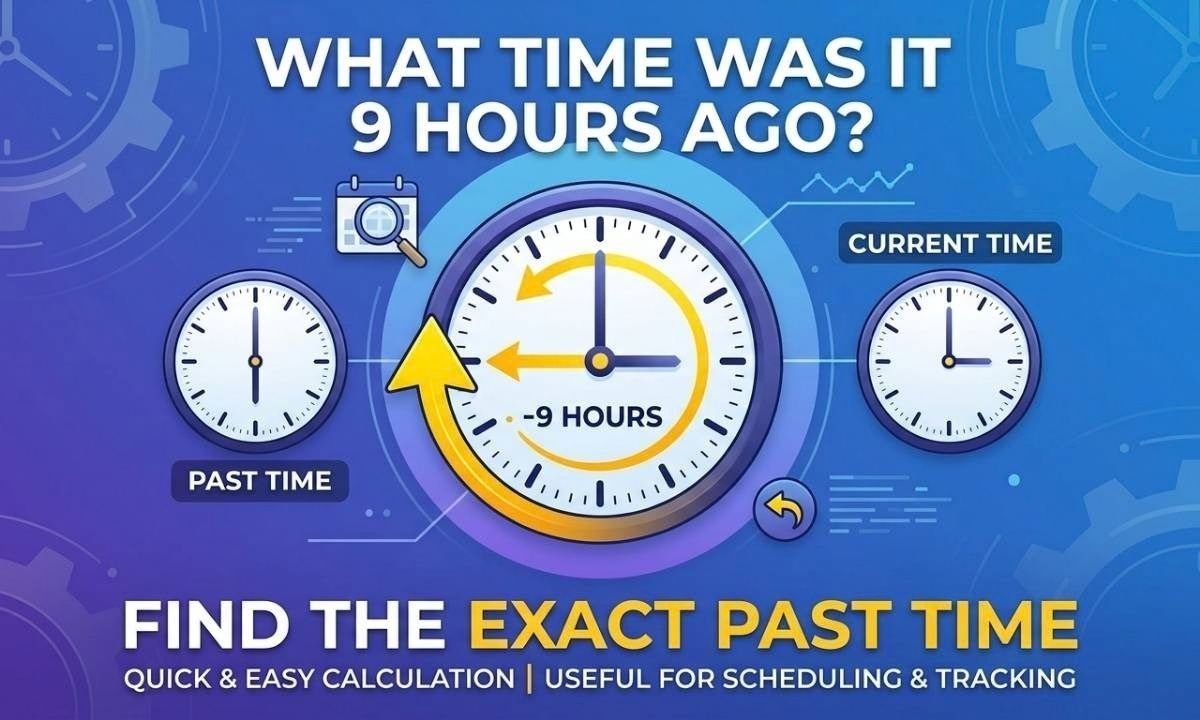
What time was it 9 hours ago? Take the current time and count back nine hours. If it’s 3:00 PM now, it was 6:00 AM. If it’s 7:00 AM now, it was 10:00 PM the night before.
People ask this when they’re checking a delivery, retracing a long day, or matching a timestamp in another time zone. The math is simple once you know how midnight and AM/PM affect it.
This guide covers the exact method, a quick-reference table, time zone examples, common mistakes, and the formula computers use. By the end, working out what time was it 9 hours ago will take you a few seconds.
How Long Ago Was 9 Hours From Now?
“9 hours from now” points to the future, while “9 hours ago” points to the past. Both use the same amount of time in opposite directions.
Nine hours equals:
- 540 minutes
- 32,400 seconds
- 0.375 of a day (three-eighths of 24 hours)
If a moment was nine hours ago, 540 minutes have passed since then.
What Time Will It Be 9 Hours From Now?
To find the time nine hours ahead, add 9 to the current hour. The minutes never change.
- 10:00 AM + 9 hours = 7:00 PM (same day)
- 4:00 PM + 9 hours = 1:00 AM (next day)
- 11:45 PM + 9 hours = 8:45 AM (next day)
What Was the Time 9 Hours Ago Today?
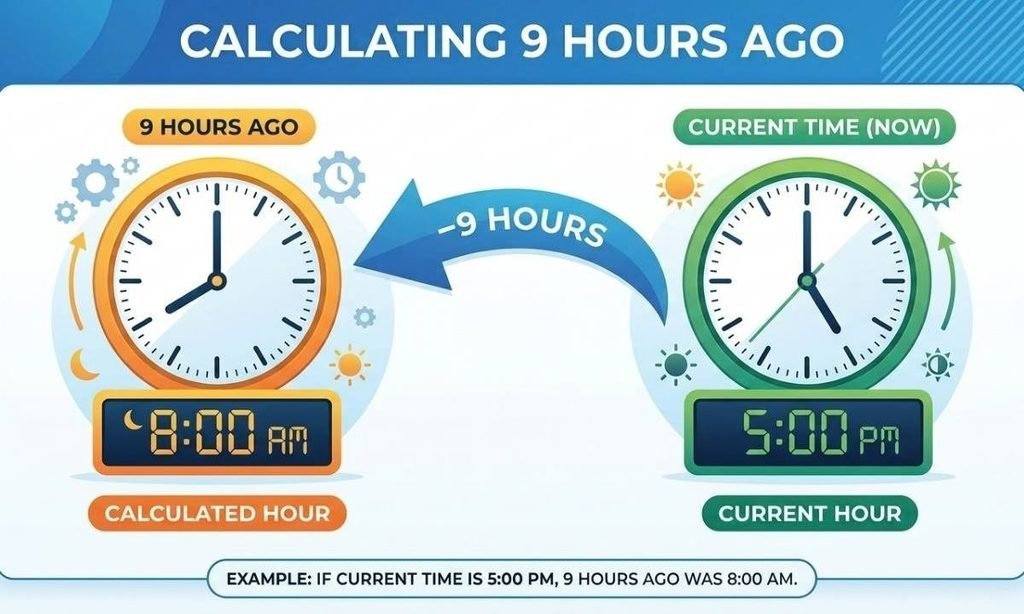
For what time was it 9 hours ago at 9:00 AM or later, the answer lands on today’s date. You don’t cross midnight, so you simply subtract.
- 9:00 AM now → 12:00 AM (midnight) today
- 1:15 PM now → 4:15 AM today
- 6:40 PM now → 9:40 AM today
What Was the Time 9 Hours Ago Yesterday?
When you ask what time was it 9 hours ago before 9:00 AM, the answer falls on yesterday. Subtracting nine hours pushes you past midnight.
- 8:00 AM now → 11:00 PM yesterday
- 5:30 AM now → 8:30 PM yesterday
- 12:20 AM now → 3:20 PM yesterday
Why Do People Want to Know What Time It Was 9 Hours Ago?
Typing “what time was it 9 hours ago” into a search box may sound odd, but nine hours is close to a full workday or a long sleep, so it comes up often.
- Sleep tracking: finding when you last woke up or went to bed.
- Work shifts: checking when a shift began.
- Deliveries and logs: matching an update to a real clock time.
- Time zones: learning what a colleague or relative was doing earlier.
- Timestamps: reading a message that says “9 hours ago.”
A Guide to Understanding Time Arithmetic
Time arithmetic is ordinary subtraction with two twists. A day has 24 hours, and clocks loop back to the start after midnight.
- Hours wrap around. After 12 comes 1 on a 12-hour clock.
- Minutes stay put. Subtracting whole hours never changes them.
- The date can change. Crossing midnight moves you to the previous day.
If It Is 7 AM Now, What Time Was It 9 Hours Earlier?
This is a classic case of what time was it 9 hours ago at 7:00 AM. The answer is 10:00 PM on the previous day.
- Write 7 AM as 07:00.
- Subtract 9: 7 − 9 = −2.
- A negative result means you crossed midnight, so add 24: −2 + 24 = 22.
- 22:00 is 10:00 PM, and it belongs to yesterday.
Calculating 9 Hours Earlier Using the 12-Hour Clock
On a 12-hour clock, nine hours is twelve hours minus three.
- Go back 12 hours by flipping AM and PM. (AM to PM means yesterday.)
- Add 3 hours.
At 7:00 AM: flip to 7:00 PM yesterday, add 3 hours, and you get 10:00 PM yesterday. At 3:00 PM: flip to 3:00 AM, add 3 hours, and you get 6:00 AM.
How to Work Out 9 Hours Ago Without Using a Calculator

You don’t need a phone to learn what time was it 9 hours ago. Three steps are enough.
Step 1: Determine the Current Time
Start with an accurate time, including AM or PM, and confirm the time zone.
Step 2: Subtract 9 Hours From the Current Time
Subtract 9 from the hour only. Leave the minutes alone.
- 15:30 − 9 hours = 06:30
- 11:10 − 9 hours = 02:10
- 20:45 − 9 hours = 11:45
Step 3: Add 24 Hours When Needed
If subtracting gives zero or a negative number, add 24 to the hour and move the date back one day.
- 06:00 − 9 = −3, then −3 + 24 = 21:00 (9:00 PM yesterday)
- 02:30 − 9 = −7, then −7 + 24 = 17:30 (5:30 PM yesterday)
Understanding When the Previous Day Comes Into Play
The previous day appears whenever the current time is earlier than 9:00 AM. At exactly 9:00 AM, you land on midnight, which starts today.
At 8:59 AM, you land at 11:59 PM yesterday. Treat 9:00 AM as the boundary line.
A Simple Breakdown of 9 Hours
Splitting nine hours into chunks can help:
- 9 hours = 12 hours − 3 hours
- 9 hours = 10 hours − 1 hour
The 10-hour version is handy. From 2:00 PM, going back ten hours gives 4:00 AM, and adding one hour back gives 5:00 AM.
| Current Time | 9 Hours Ago |
| 12:00 AM | 3:00 PM (yesterday) |
| 3:00 AM | 6:00 PM (yesterday) |
| 6:00 AM | 9:00 PM (yesterday) |
| 8:00 AM | 11:00 PM (yesterday) |
| 9:00 AM | 12:00 AM (today) |
| 12:00 PM | 3:00 AM (today) |
| 3:00 PM | 6:00 AM (today) |
| 6:00 PM | 9:00 AM (today) |
| 9:00 PM | 12:00 PM (today) |
Calculating Past Time With a Time Calculator
A time calculator is the fastest way to find what time was it 9 hours ago when the date or time zone is involved.
- Enter the starting date and time, or use the current time.
- Choose “subtract” and set 9 hours.
- Read the result, including the date.
Good tools also account for daylight saving time and let you pick a time zone. Use one to double-check your own math whenever the answer crosses midnight or a clock change.
How Do Time Zones Affect the Calculation?
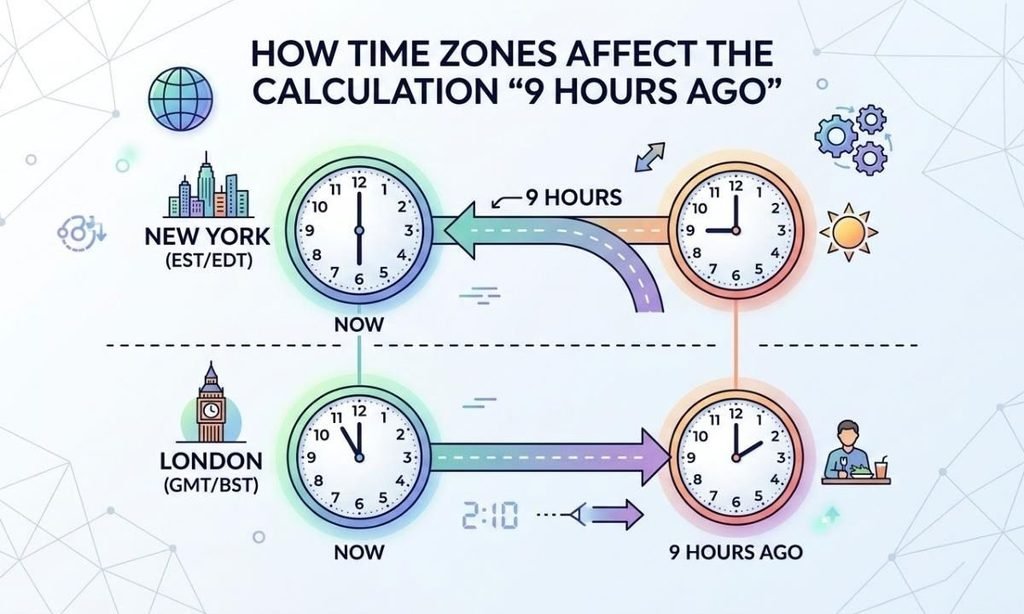
Nine hours lasts the same everywhere, but the clock reading changes with location. To learn what time was it 9 hours ago in a specific place, start with that place’s local time.
Here are the usual offsets from UTC. Regions with daylight saving switch between two offsets.
- Eastern: UTC−5 in winter, UTC−4 in summer
- Central: UTC−6 in winter, UTC−5 in summer
- Pacific: UTC−8 in winter, UTC−7 in summer
- United Kingdom: UTC+0 in winter, UTC+1 in summer
- Sydney and Melbourne: UTC+10 in winter, UTC+11 in summer
What Was the Time 9 Hours Ago in Eastern Time?
Subtract nine hours from the current Eastern Time. At 3:00 PM ET, it was 6:00 AM ET. At 2:00 AM ET, it was 5:00 PM ET yesterday.
What Was the Time 9 Hours Ago in Pacific Time?
Pacific Time works the same way. At 8:00 AM PT, nine hours earlier was 11:00 PM PT yesterday. The Pacific is three hours behind Eastern.
What Was the Time 9 Hours Ago in California?
California follows Pacific Time, so use PST or PDT depending on the season. At 10:30 AM in Los Angeles, it was 1:30 AM there nine hours earlier.
What Was the Time 9 Hours Ago in the UK?
The UK uses GMT in winter and British Summer Time in summer. At 2:00 PM in London, it was 5:00 AM in London. Use London’s local clock, not UTC.
What Was the Time 9 Hours Ago in the Morning?
Morning times often lead to yesterday. At 6:00 AM, nine hours ago was 9:00 PM yesterday. At 11:00 AM, it was 2:00 AM today.
What Was the Time 9 Hours Ago in Central Time?
Central Time is one hour behind Eastern. At 1:00 PM CT, it was 4:00 AM CT. At 7:30 AM CT, it was 10:30 PM CT yesterday.
What Was the Time 9 Hours Ago in Australia?
Australia has several time zones, so choose the city first. Sydney and Melbourne observe daylight saving, Brisbane does not, and Perth uses UTC+8. At 10:00 AM in Sydney, it was 1:00 AM in Sydney.
How 9-Hour Time Calculations Apply to Everyday Life
Knowing what time was it 9 hours ago has practical uses beyond trivia.
Keeping Track of Sleep Schedules
If you wake at 7:00 AM and want nine hours in bed, you need to be asleep by 10:00 PM.
Recalling Past Conversations
If a call happened “about nine hours ago,” subtract nine hours from now to estimate when it took place.
Managing Medication Reminders
Subtracting hours gives a clear time to tell a doctor or pharmacist. For dosing questions, follow their instructions rather than doing your own math.
Calculating Work Shifts
Nine hours is a common shift length once breaks are included. If a shift ended at 5:30 PM, it started at 8:30 AM. If it ended at 6:00 AM, it started at 9:00 PM the night before.
Common Errors When Subtracting 9 Hours
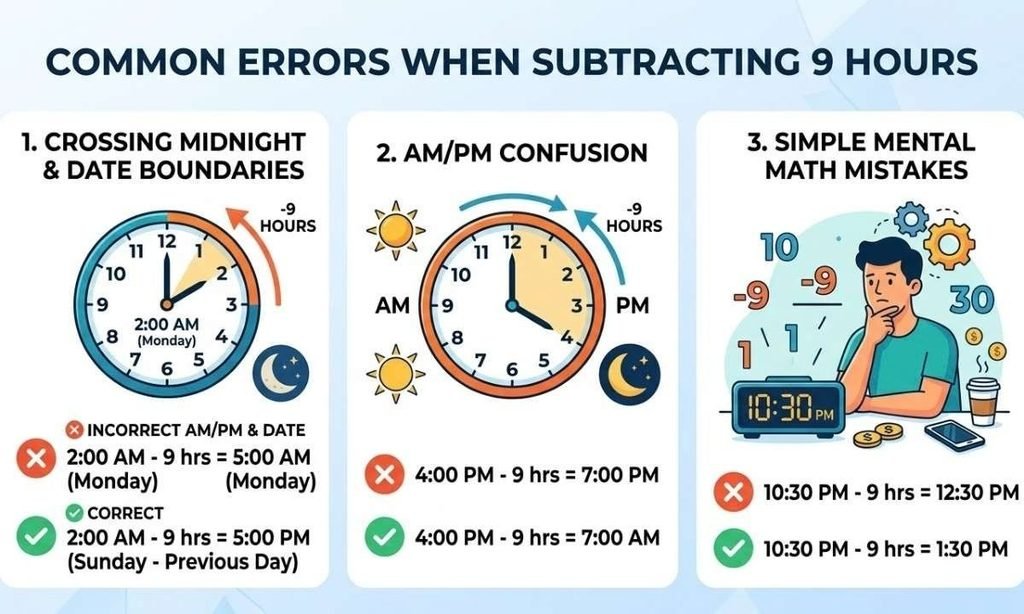
Most mistakes fall into four groups. Checking your work matters when the answer to what time was it 9 hours ago affects a real decision.
Overlooking Midnight
The most common slip is forgetting to change the date. Subtracting 9 from 3:00 AM gives −6, which becomes 6:00 PM yesterday, not today.
Confusing AM With PM
Noon and midnight cause trouble. 12:00 PM is noon, and 12:00 AM is midnight. When unsure, switch to a 24-hour clock.
Not Considering Time Zones
If your starting time belongs to another region, the result will be off. Convert to the right zone first, then subtract.
Subtracting From the Incorrect Hour
Use the exact time you care about, not an old or rounded one. Don’t change the minutes either: 4:47 PM minus nine hours is 7:47 AM, not 7:00 AM.
An Easy Guide to Reverse Time Calculations
Answering what time was it 9 hours ago is a reverse time calculation: working backward from a known time. This routine works for any number of hours:
- Write the time in 24-hour format.
- Subtract the hours.
- If the answer is negative, add 24 and move the date back one day.
- Convert back to AM/PM if needed.
Example: 01:20 minus 9 hours is −7:20. Add 24 hours and you get 17:20, or 5:20 PM yesterday.
Why Are Online Time Calculators So Widely Used?
Online calculators remove the guesswork. If you’ve ever wondered what time was it 9 hours ago while juggling a deadline, you know why a tool is tempting.
- Accuracy: they handle midnight and date changes.
- Time zone support: many convert between regions.
- Daylight saving awareness: good tools adjust for clock changes.
Knowing the manual method still helps you catch a wrong input, such as the wrong time zone.
Practical Examples of 9-Hour Time Calculations
Here’s how the method works in real situations, each answering what time was it 9 hours ago from a different starting point.
- Delivery log: at 4:15 PM, nine hours ago was 7:15 AM today.
- Night shift review: at 5:00 AM, it was 8:00 PM yesterday.
- Message timestamp: at 9:30 AM, it was 12:30 AM today.
- Flight update: at 2:05 AM, it was 5:05 PM yesterday.
How Human Memory Relates to Time
People aren’t naturally good at judging how long ago something happened. We often estimate by events, such as “before lunch” or “after the meeting,” rather than by the clock.
That’s why the question of what time was it 9 hours ago tends to come up when memory isn’t enough. Phone timestamps, call logs, and written notes give you a reliable anchor.
Understanding Timestamps in Digital Messages
Apps often show relative times like “9 hours ago” instead of a full date. Behind the scenes, the system saves an exact moment and compares it with the current time.
Many systems store timestamps in UTC, a common global reference. Your device converts that value to local time when it displays it.
Exploring Time Zones Across the Globe
Time zones are based on offsets from UTC. Most are whole-hour offsets, but a few use half-hour or 45-minute offsets, such as India (UTC+5:30) and Nepal (UTC+5:45).
- Countries change clocks on different dates, or not at all.
- The same city can have different offsets in winter and summer.
- Crossing the International Date Line changes the calendar date.
So when someone asks what time was it 9 hours ago in another country, find that country’s local time first. Don’t apply your own offset.
How Computers Calculate Time Differences
Computers store time as one number, often the seconds since January 1, 1970 in UTC, known as Unix time. That makes subtraction easy.
Nine hours is 32,400 seconds. A program subtracts 32,400 from the stored value, then converts the result to a local time zone using a database of zone rules.
One detail is worth knowing. If a clock change happened during the last nine hours, the local reading can differ by an hour from simple subtraction. The elapsed time is still nine hours, but the wall clock skipped or repeated an hour.
The Manual Formula for Calculating Time Differences
You can turn the whole method into one formula for a 24-hour clock:
Past hour = (current hour − 9 + 24) mod 24
“Mod 24” means “keep the remainder after dividing by 24.” It wraps the number back onto the clock. This is the same math behind every tool that answers what time was it 9 hours ago.
- Current hour 15: (15 − 9 + 24) mod 24 = 6 → 6:00 AM
- Current hour 4: (4 − 9 + 24) mod 24 = 19 → 7:00 PM (yesterday)
- Current hour 9: (9 − 9 + 24) mod 24 = 0 → 12:00 AM
Keep the minutes as they are, and adjust for a time zone or daylight saving change if needed.
Frequently Asked Questions
What time was it 9 hours ago?
Subtract 9 from the current hour and keep the minutes. If the result is zero or negative, add 24 and use the previous day.
How do I calculate 9 hours ago from now?
Count back nine hours from the current time and check whether you crossed midnight. If you did, the answer belongs to yesterday.
What time was it 9 hours ago if it is 7 AM now?
It was 10:00 PM the previous day.
What time was it 9 hours ago in Eastern Time?
Subtract nine hours from the current Eastern Time. For example, 3:00 PM ET becomes 6:00 AM ET.
Is 9 hours ago yesterday or today?
It’s today if the current time is 9:00 AM or later, and yesterday if it’s before 9:00 AM.
How many minutes and seconds are in 9 hours?
Nine hours equals 540 minutes, or 32,400 seconds.
Does daylight saving time change the answer?
It can. If your clocks changed within the last nine hours, the local reading may differ by an hour from simple subtraction.
What is the easiest trick to subtract 9 hours?
Subtract 10 hours and add 1 hour back, or go back 12 hours and add 3.
How do I find 9 hours ago in another time zone?
Find the current local time in that zone first, then subtract nine hours from it.
Conclusion
Working out what time was it 9 hours ago comes down to a few steps: start with the current time, subtract nine hours, and adjust the date if you cross midnight. The key line to remember is 9:00 AM. At or after it, the answer is today. Before it, the answer is yesterday.
Use the shortcuts, the reference table, or a calculator when accuracy matters. Once you understand the logic, you can answer what time was it 9 hours ago in any time zone with confidence.