

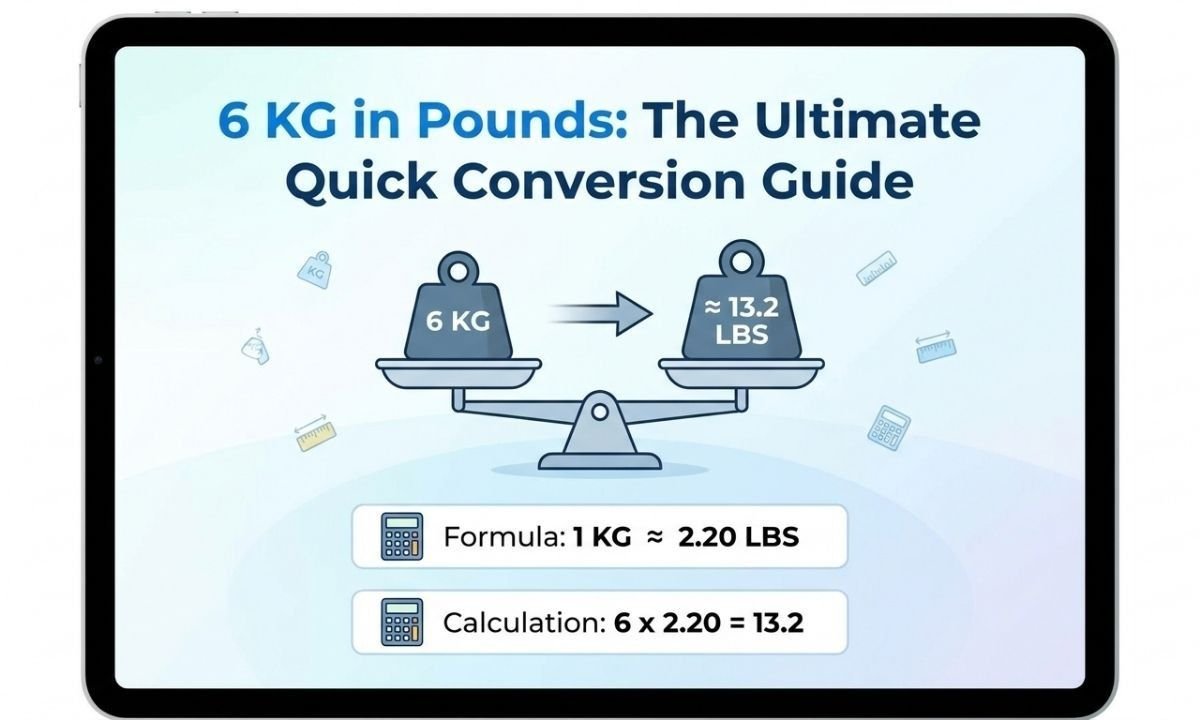
6 kg in pounds is roughly 13.23 lb, and that is the number most people need when a luggage limit, a recipe, or a gym weight uses a different unit than the one they know.
Here is the short answer first, then the details. This guide covers 6 kg in pounds, ounces, grams, and liters. It also shows everyday objects that weigh about the same, so you can picture the number instead of just reading it.
Whether you are packing a bag, checking a baby’s weight, or buying a kettlebell, the quick maths and real-world examples below will help.
6 kg Converted Into Different Units of Measurement
The kilogram is the base unit of mass in the metric system, so 6 kg converts neatly into many other units. Before we focus on 6 kg in pounds, here is the full picture.
| Unit | 6 kg Equals |
| Grams (g) | 6,000 g |
| Milligrams (mg) | 6,000,000 mg |
| Pounds (lb) | 13.23 lb |
| Ounces (oz) | 211.64 oz |
| Stone (st) | 0.945 st |
| Metric tonnes (t) | 0.006 t |
| US short tons | 0.0066 tons |
Pounds and ounces are common in the United States. The UK often mixes stone and pounds for body weight. Most other countries stick with kilograms and grams.
This mix of systems is why conversions come up so often. A product made in Europe may be labeled in kilograms, while the shop selling it in the US shows pounds.
Knowing 6 kg in pounds saves you from guessing at the checkout, at the airport, or in the gym.
How Much Is 6 kg in Pounds and Ounces?
Six kilograms is 13 pounds and 3.64 ounces. In decimal form, that is 13.23 lb. If you only need 6 kg in pounds for a quick estimate, 13.2 lb is accurate enough for most daily tasks.
The split into pounds and ounces works like this:
- The whole number, 13, is the count of full pounds.
- The leftover 0.2277 lb is multiplied by 16, because one pound has 16 ounces.
- That gives 3.64 oz, so the full result is 13 lb 3.64 oz.
If your kitchen scale only shows ounces, look for about 211.6 oz. For shipping labels, rounding up to 13 lb 4 oz keeps you on the safe side.
Which version should you use? Use 13.23 lb for calculations and online forms, and 13 lb 3.64 oz when a scale shows pounds and ounces separately. In casual conversation, saying thirteen pounds is perfectly fine.
How 6 kg Equals Approximately 13.23 Pounds
The conversion rests on one fixed number. One kilogram equals 2.20462 pounds. Multiply the kilograms by that factor, and you have your answer.
Formula: pounds = kilograms × 2.20462
Here is the step-by-step version:
- Start with 6 kg.
- Multiply 6 by 2.20462.
- The result is 13.22772.
- Round to two decimals to get 13.23 lb.
That is the whole process behind 6 kg in pounds, and it works for any weight.
A mental shortcut: double the kilograms, then add 10% of that result. Double 6 is 12, and 10% of 12 is 1.2, so you get 13.2 lb. This shortcut lands 6 kg in pounds within 0.03 lb of the exact figure, which is fine for shopping or travel.
To go the other way, divide pounds by 2.20462. For example, 13.23 lb divided by 2.20462 returns 6 kg.
Here is a quick reference table for nearby weights, so you can see how the numbers climb:
| Kilograms | Pounds |
| 1 kg | 2.20 lb |
| 2 kg | 4.41 lb |
| 3 kg | 6.61 lb |
| 4 kg | 8.82 lb |
| 5 kg | 11.02 lb |
| 6 kg | 13.23 lb |
| 7 kg | 15.43 lb |
| 8 kg | 17.64 lb |
| 9 kg | 19.84 lb |
| 10 kg | 22.05 lb |
Every extra kilogram adds about 2.2 pounds, so you can always rebuild 6 kg in pounds from the row above or below it.
How Many Grams Are Equal to 6 kg?
One kilogram holds 1,000 grams, so 6 kg is exactly 6,000 grams. There is no rounding at all, because both units sit in the same metric family.
Just move the decimal point three places to the right. This is far simpler than working out 6 kg in pounds, where the factor is not a round number. For scale, 6,000 grams is about the weight of 6,000 standard paperclips.
This is handy in the kitchen and at the post office. A recipe asking for 6,000 g of flour is the same as 6 kg, and many parcel services price in 500 g or 1 kg steps. If you ever see grams and kilograms mixed on one label, convert everything to grams first and the sums become easy.
Why Converting 6 kg to Liters Depends on the Material
Kilograms measure mass. Liters measure volume. Because they describe different things, you cannot convert one into the other without knowing the density of the material.
Unlike 6 kg in pounds, which is a straight mass-to-mass conversion, liters need that extra piece of information.
Formula: liters = kilograms ÷ density (in kg per liter)
| Material | Approx. Density (kg/L) | 6 kg in Liters |
| Water | 1.00 | 6.00 L |
| Milk | 1.03 | 5.83 L |
| Cooking oil | 0.92 | 6.52 L |
| Honey | 1.42 | 4.23 L |
| Petrol | 0.74 | 8.11 L |
Lighter liquids take up more space for the same mass. Heavier ones, like honey, take up less. Densities vary slightly with brand and temperature, so treat these values as close estimates.
In practice, this matters most when you buy liquids by weight but measure them by volume, or the other way round.
A recipe, a fuel tank, or a fish tank can each use a different unit. Always check the density first, and the result will be reliable.
Does 6 kg of Water Equal 6 Liters?
For everyday purposes, yes. The metric system was built so that one liter of pure water weighs about one kilogram. That makes 6 kg of water almost exactly 6 liters.
Strictly speaking, the match is perfect only at about 4°C. At room temperature (around 20°C), a liter of water weighs about 0.998 kg, so 6 kg would be roughly 6.01 liters.
The difference is tiny. It is also why water makes such a handy reference when you need to picture 6 kg in pounds as a real object.
This is why many people use water as a home test weight. Fill containers with a known number of liters, and you have an instant, free set of weights. Just remember that the container itself adds a little extra, so the total will be slightly above 6 kg.
15 Everyday Things That Weigh Around 6 kg
Abstract numbers are easy to forget. Familiar objects are not. These 15 examples all land close to 6 kg, which is about 13.2 pounds. Exact weights vary by brand and size, so think of each one as a reasonable approximation.
1. Six One-Liter Bottles of Water

This is the easiest benchmark to build at home. Six full one-liter bottles weigh just over 6 kg once you count the plastic. Carry them in a bag and you will feel the weight right away.
2. A Medium-Sized Watermelon
A medium watermelon usually weighs somewhere between 4 and 6 kg. A good one at the upper end gives you a natural picture of what 6 kg feels like in your arms.
3. A 6 kg Dumbbell
Gyms and home workout sets often include a 6 kg dumbbell, which is a clean example of 6 kg in pounds at 13.23 lb. Some US dumbbells are labeled 12 or 15 lb, so check the unit on the handle.
4. A Large Domestic Cat
Most house cats weigh 3 to 5 kg. A large, well-fed cat, or a bigger breed such as a Maine Coon, can easily reach 6 kg. Vets often use that range when discussing healthy weight.
5. A Full 5-Liter Can of Paint
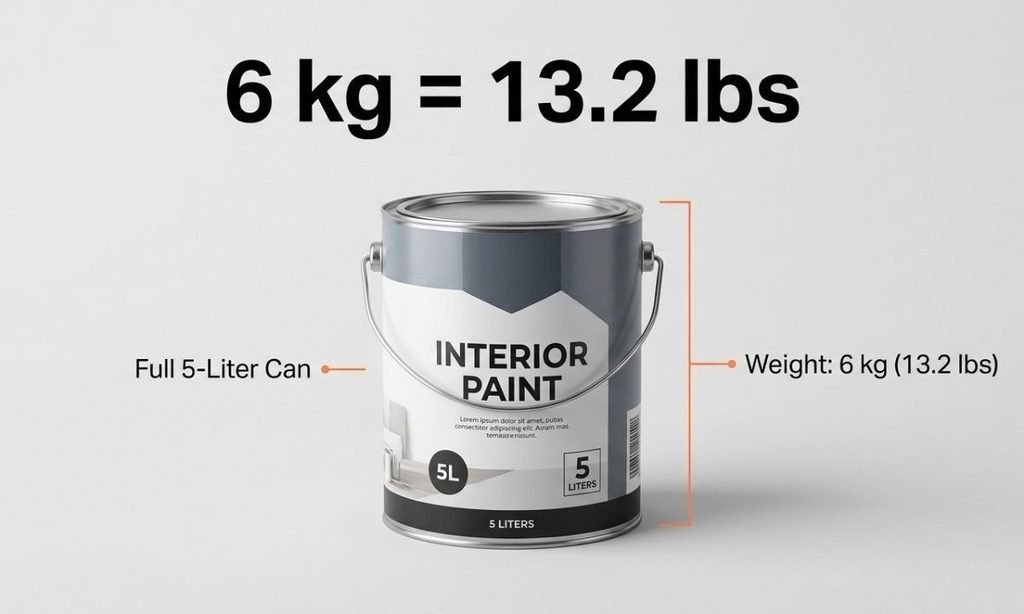
Paint is denser than water. A five-liter can of emulsion usually weighs around 6 to 7 kg with the metal can included. It is a good reminder that volume alone does not tell you the weight.
6. A Bowling Ball Weighing Around 13 Pounds
Bowling balls are sold by the pound. A 13 lb ball weighs about 5.9 kg, which is nearly the same as 6 kg in pounds. It is one of the closest everyday matches you will find.
7. A Baby Around Three Months Old
A typical three-month-old baby weighs somewhere near 6 kg. That makes 6 kg in pounds, about 13 lb, a familiar milestone on many growth charts. Babies vary a lot, so this is only a general guide.
8. A 6 kg Kettlebell
Kettlebells are often sold in 2 kg steps, so 6 kg is a standard beginner size. Its off-center handle makes it feel heavier than a dumbbell of the same weight.
9. A Canister-Style Vacuum Cleaner
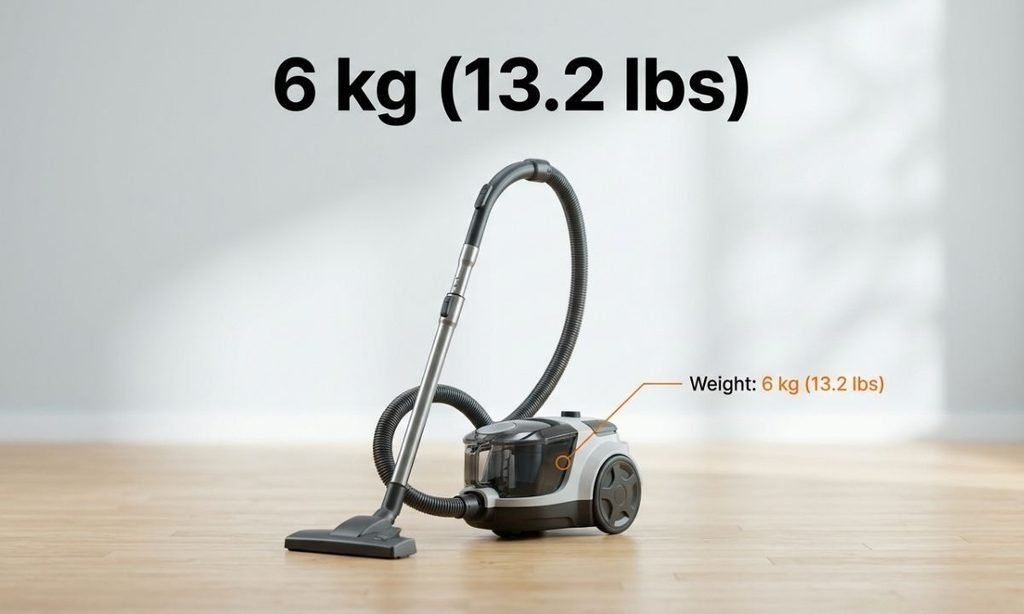
Many canister vacuums weigh between 4 and 7 kg. A mid-range model often sits close to 6 kg, which explains why carrying one up the stairs feels like a small workout.
10. A 6 kg Sledgehammer
Heavy-duty sledgehammers come in several sizes, and the larger demolition models can reach 6 kg. Swinging that much weight on a long handle takes real strength and control.
11. A Whole Turkey
A 6 kg turkey is about 13 pounds, which is a very typical size for a family holiday meal. It would feed roughly eight to ten people.
12. A Small Bag of Dog Food
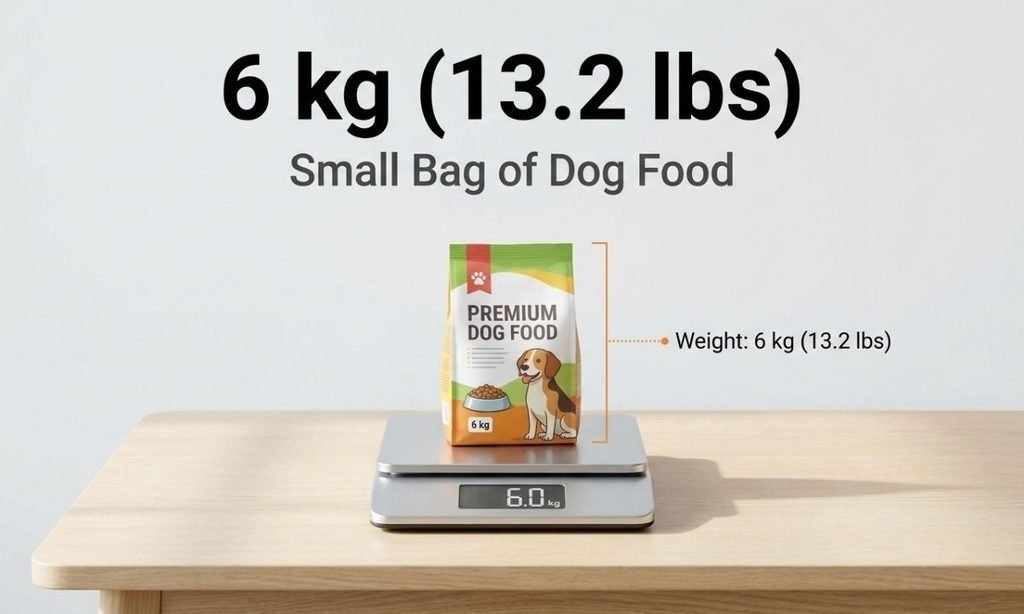
Dog and cat food brands often sell 6 kg bags. If you buy kibble regularly, you already know exactly how this weight feels when you lift it from the trunk of the car.
13. A Large Cast-Iron Cooking Pot
Cast iron is famously heavy. A large Dutch oven or stockpot can weigh between 5 and 7 kg, especially when it has its lid on. Add food, and it becomes heavier still.
14. A Compact Microwave Oven
The smallest microwave ovens are lighter than standard ones, though many still weigh 7 to 10 kg. A very compact model can come close to 6 kg, so check the specification label before you assume.
15. A Packed Travel Bag
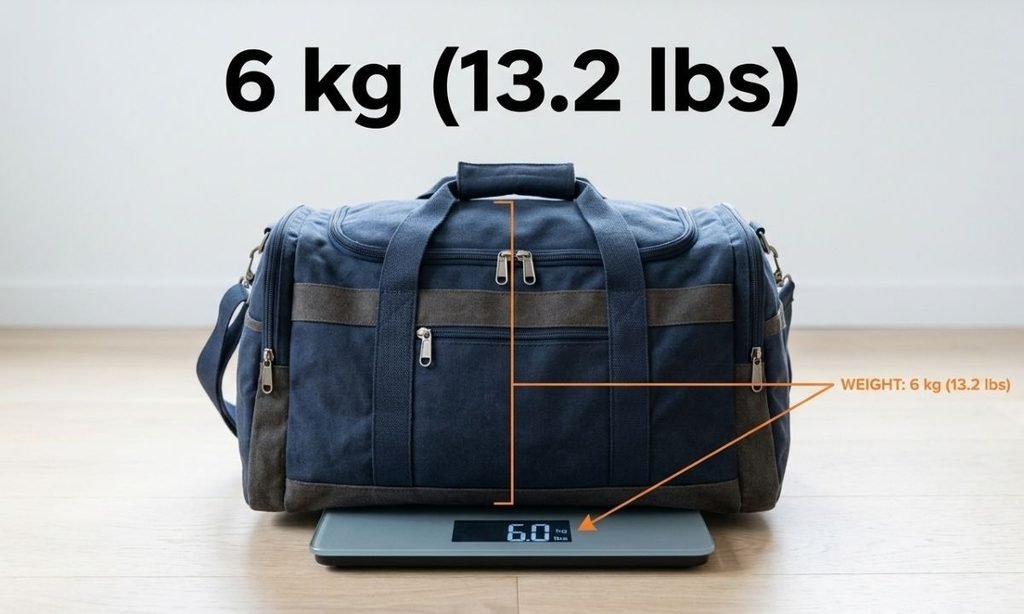
A well-packed cabin bag often weighs 6 to 8 kg. If your airline allows 7 kg or more, keeping the bag near 6 kg gives you room for souvenirs on the way back.
How Does 6 kg Compare to 5 kg and 10 kg?
Comparisons make a number easier to judge. Here is how 6 kg in pounds sits next to two other common weights.
| Weight | Pounds | Pounds and Ounces |
| 5 kg | 11.02 lb | 11 lb 0.37 oz |
| 6 kg | 13.23 lb | 13 lb 3.64 oz |
| 10 kg | 22.05 lb | 22 lb 0.74 oz |
Moving from 5 kg to 6 kg adds 1 kg, or about 2.2 pounds. That is a 20% jump, which you can feel clearly when lifting. Going from 6 kg to 10 kg adds 4 kg, or 8.82 pounds. Put another way, 6 kg in pounds is about 40% lighter than 10 kg.
Is 6 kg Considered Heavy to Lift or Carry?
For most healthy adults, 6 kg is light to moderate. It is about the weight of a full shopping bag, and carrying it for a short distance is easy. Lifting it from the floor a few times causes no trouble.
It starts to feel heavy in a few situations:
- Carrying it for a long time, such as a loaded backpack on a hike
- Holding it away from your body or above your head
- Lifting it repeatedly, as in a warehouse or a workout
- Moving it with a weaker back, a recent injury, or a younger body
For children, 6 kg in pounds (about 13 lb) is heavy for a school bag. Many guidelines suggest keeping a child’s bag to a small fraction of their body weight.
When in doubt, bend your knees, keep the load close, and avoid twisting while you lift.Technique matters as much as strength. Keep your back straight, hold the object close to your chest, and lift with your legs rather than your spine.
If you are unsure how an object will feel, remember that 6 kg in pounds is just over 13 lb, about the same as a large bag of potatoes. That is easy for most adults but worth taking seriously for anyone with back problems.
How Can You Estimate 6 kg Without a Weighing Scale?
You do not always have a scale nearby. These simple tricks get you close:
- Use water bottles. Six one-liter bottles equal about 6 kg.
- Compare with a known item. A 5 kg bag of rice plus a 1 kg bag of sugar gives you a reliable reference.
- Weigh yourself twice. Step on a bathroom scale alone, then holding the object. Subtract the first reading from the second.
- Use a luggage scale. A small hanging scale is cheap and handy for bags and boxes.
- Weigh in portions. If your kitchen scale tops out at 2 kg, weigh the item in three parts and add them up.
To check an estimate in pounds, simply apply the rule for 6 kg in pounds: multiply by 2.2, or double and add 10%.
Accuracy depends on your method. Water bottles and bathroom scales are usually accurate within a few hundred grams, which is fine for packing or cooking.
For anything that affects safety or cost, such as medicine, shipping charges, or airline fees, use a properly calibrated scale instead.
What Household Objects Weigh Close to 6 kg?
Many items around the house land near this weight, even if the label does not say so:
- A 5 kg bag of rice with a 1 kg bag of sugar
- A bag of potatoes from the supermarket
- A standard bag of cat litter
- A toaster oven or small air fryer
- A fully loaded daily backpack
- A large pumpkin in autumn
Pick two or three of these and lift them. After a few tries, 6 kg in pounds stops being a number and becomes a feeling you can recognize.
Other Common Reasons People Search for 6 kg Measurements
People usually look up this weight for a practical reason. The most common ones include:
- Air travel: Cabin and hand luggage limits are often set in kilograms.
- Baby and child weight: Parents compare growth charts that use pounds or kilograms.
- Pet care: Vets and food brands may list a cat or small dog’s ideal weight in kg.
- Fitness: Dumbbells, kettlebells, and weight plates differ between metric and imperial markings.
- Shipping: Parcel services price by weight, so 6 kg in pounds helps you compare rates between US and international carriers.
- Cooking: Recipes for large cuts of meat, such as a turkey or a roast, list kilograms or pounds.
As you can see, the same weight shows up in very different parts of life. That is why a quick conversion helps so much, and why it is worth remembering the multiplication factor of 2.2.
Once it becomes second nature, you can switch between kilograms and pounds without opening a calculator.
Frequently Asked Questions
What Is 6 kg in Pounds?
6 kg equals about 13.23 pounds, or exactly 13.22772 pounds if you need more decimals.
How Many Ounces Are in 6 kg?
6 kg equals about 211.64 ounces, which is 13 pounds and 3.64 ounces.
How Many Grams Are in 6 kg?
6 kg is exactly 6,000 grams. Multiply kilograms by 1,000 to get grams.
How Do I Convert Kilograms to Pounds Quickly?
Multiply by 2.2, or double the kilograms and add 10%. For 6 kg, that gives about 13.2 pounds.
Is 6 kg the Same as 6 Liters?
Only for water, where 6 kg is about 6 liters. Other materials have different densities, so the volume changes.
How Many Stone Is 6 kg?
6 kg is about 0.945 stone, which is just under one stone (6.35 kg).
Is 6 kg Heavy?
For a healthy adult, no. It is light to moderate for short carries, but it can feel heavy over long periods or for children.
Is 6 kg Within Cabin Baggage Limits?
Often yes, since many airlines allow 7 to 10 kg of hand luggage. Always check your specific airline’s rules before you fly.
What Is 13 Pounds in Kilograms?
13 pounds is about 5.9 kg. Divide pounds by 2.20462 to convert them to kilograms.
Conclusion
Knowing 6 kg in pounds, about 13.23 lb or 13 lb 3.64 oz, makes everyday decisions easier, from packing a suitcase to choosing a dumbbell. Use the formula for accuracy, the double-plus-10% trick for speed, and the real-world examples to build a feel for the weight.
Whether you are checking a baby’s weight, weighing luggage, or comparing parcel rates, a quick conversion saves time and prevents costly mistakes. A little practice with the multiplication factor of 2.2 is all it takes to switch between kilograms and pounds with confidence.